
Book 00 · Page 3535 / 80
Fluids: hypotonic, isotonic, hypertonic
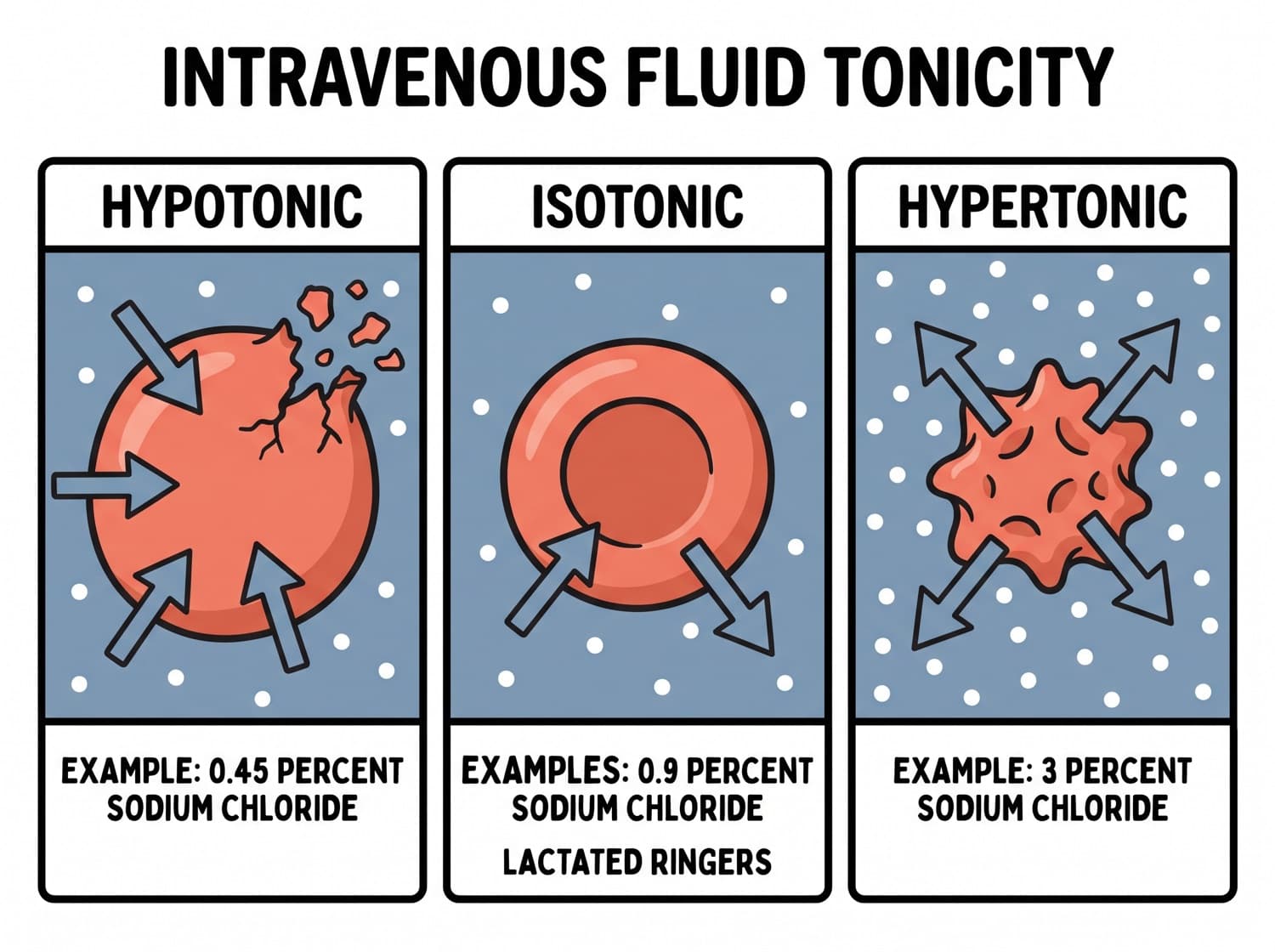
Hypotonic
- Where the water goes — out of the vessel and into the cell. Cells swell.
- The solutions — one-half normal saline.
- The patient it is for — cellular dehydration, hypernatremia.
- The patient it harms — head injury or anyone at risk of cerebral edema; also the hypovolemic patient, because the fluid does not stay where it is needed.
- What you watch — level of consciousness.
Isotonic
- Where the water goes — nowhere. It stays in the vascular compartment.
- The solutions — normal saline, lactated Ringer's.
- The patient it is for — hypovolemia, hemorrhage, losses from vomiting or diarrhea.
- The patient it harms — heart failure and renal failure, through volume overload. Lactated Ringer's contains potassium, so it is avoided in hyperkalemia, and it is metabolized by the liver, so it is questioned in hepatic failure.
- What you watch — lung sounds and daily weight.
Hypertonic
- Where the water goes — pulled out of the cell into the vessel. Cells shrink.
- The solutions — 3 percent saline, the dextrose-containing combinations.
- The patient it is for — symptomatic hyponatremia, cerebral edema.
- The patient it harms — heart failure, and dehydration caused by cellular water loss.
- What you watch — pulmonary edema; with concentrated saline, serum sodium checked frequently during the infusion.
The dextrose footnote
Five percent dextrose in water is isotonic in the bag and functionally hypotonic once the dextrose is metabolized and only free water remains. That is exactly why it is not the fluid for a patient at risk of cerebral edema.
Margin noteask which compartment you're trying to fill.
Watch outconcentrated saline is a monitored infusion, not a routine one.
Takeawaytonicity tells you which compartment gains water, and the compartment tells you the patient.
Infusion rate math → BOOK 06 · P11. Sodium correction rate → BOOK 10 · P4.