
Multi-Casualty Arrival: Triage, Tags, and a Suspected Release
The case
11:52. A community hospital emergency department with 14 treatment bays and 6 nurses on shift receives notice that an unidentified white powder was released inside a warehouse two miles away.
12:04. Fourteen people arrive within 9 minutes. Nine walk in. Five arrive on stretchers. Two of the walk-ins came by private vehicle straight to the ambulance bay and have not been decontaminated. Several report burning eyes and throat.
12:07. Rapid assessment of five non-ambulatory patients:
- Patient A, age 41, respirations 34, radial pulse present, follows commands.
- Patient B, age 58, respirations 12, radial pulse absent, capillary refill 4 seconds, confused.
- Patient C, age 29, respirations 18, radial pulse present, cannot state the year or follow a simple command.
- Patient D, age 63, apneic. Airway opened by head-tilt chin-lift. Still apneic after repositioning.
- Patient E, age 8, apneic. Airway opened. Still apneic; a carotid pulse is present.
12:15. The department has not been locked down. Incident command has not been notified.
CUE · Recognize cues. Which finding at 12:04 is the most significant?
- Several patients report burning eyes.
- Fourteen people from one location present within 9 minutes with similar complaints.
- Nine of the fourteen are ambulatory.
- Two patients arrived by private vehicle.
ANA · Analyze cues. The nurse must separate two questions that candidates merge. Which statement is accurate?
- Contamination is on the patient; transmission is from the patient. Decontamination and isolation are different decisions.
- Any patient needing decontamination also needs airborne precautions.
- Isolation replaces decontamination once the agent is identified.
- Decontamination is deferred until the agent is named.
PRI · Prioritize hypotheses. Using the mass-casualty algorithm, how is Patient D tagged?
- Immediate, because apnea is the most life-threatening finding present.
- Delayed, because an airway maneuver was already attempted.
- Expectant, because the patient does not breathe after the airway is opened.
- Minor, because no other injury is documented.
SOL · Generate solutions. Which plan is correct for the nine ambulatory arrivals?
- Direct them into the department for assessment and tag after triage.
- Direct them away from the treatment area, tag them minor, and decontaminate before entry.
- Discharge them, since ambulatory patients are not injured.
- Place them all in airborne precautions.
ACT · Take action. Which action comes first for the two private-vehicle arrivals?
- Stop them outside the department and decontaminate before entry.
- Escort them to a treatment bay and remove clothing there.
- Obtain a history of exposure duration.
- Give them surgical masks and seat them in the waiting room.
EVA · Evaluate outcomes. At 12:40, Patient A's respirations are 40 and the radial pulse is now absent. What does the nurse do?
- Leave the delayed tag in place, since tags are assigned once.
- Re-triage and re-tag the patient as immediate.
- Move the patient to the expectant area.
- Wait for the next scheduled reassessment round.
Keyed answers: CUE 2 · ANA 1 · PRI 3 · SOL 2 · ACT 1 · EVA 2.
The pediatric variant. Patient E is the reason the pediatric branch exists. In the pediatric algorithm, an apneic child with a palpable pulse receives rescue breaths before the expectant decision is made. If breathing resumes, the child is tagged immediate.
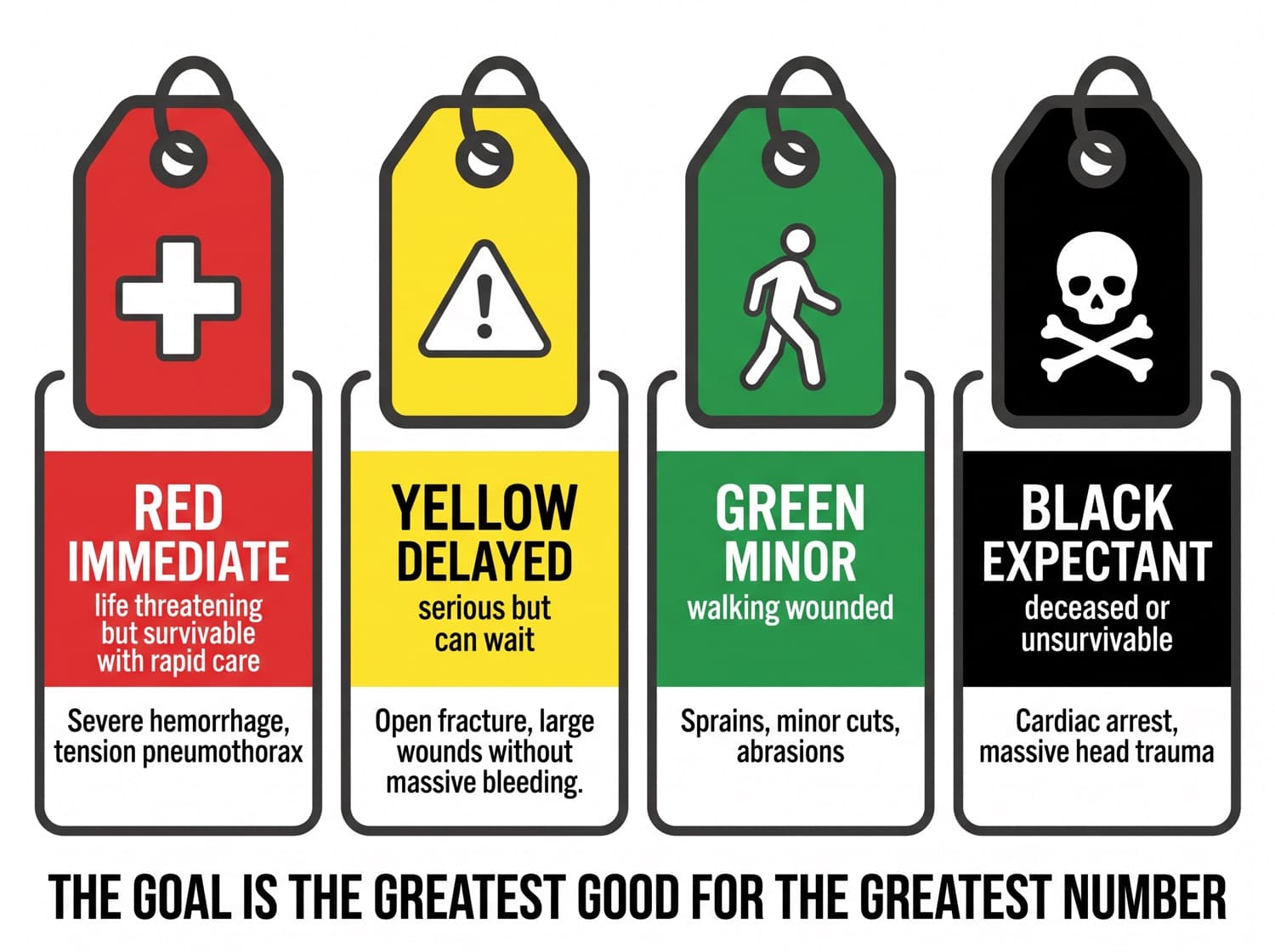
Tag colors
- Green, minor. Ambulatory, walking wounded, directed away from the treatment area.
- Yellow, delayed. Injured, but breathing, perfusing, and following commands.
- Red, immediate. A failure in respirations, perfusion, or mental status that a rapid intervention can correct.
- Black, expectant. No respirations after the airway is opened, under the adult algorithm.
Category A bioterrorism strip
| Agent | Person-to-person transmission | Precaution |
|---|---|---|
| Anthrax (Bacillus anthracis) | No | Standard, with soap and water for the spores |
| Smallpox (variola major) | Yes | Airborne plus contact |
| Plague, pneumonic (Yersinia pestis) | Yes | Droplet for the guideline's stated duration of effective therapy |
| Botulism (Clostridium botulinum toxin) | No | Standard |
| Tularemia (Francisella tularensis) | No | Standard |
| Viral hemorrhagic fevers | Yes | Standard plus contact plus droplet, with added respiratory protection during aerosol-generating procedures |
Memory hookWalking, breathing, bleeding, thinking.
Watch outIn a mass casualty the sickest patient is not the first patient. Spending three nurses on Patient D costs the four immediate patients their intervention window.
Margin noteThe tag is a snapshot.
TakeawayDisaster triage optimizes for the population, and that single change reverses the priority rule practiced everywhere else.
Prioritization frameworks belong to → BOOK 03 · P6.
Verify at reprint: triage criteria, the tag color set, and the pediatric variant against current federal mass-casualty triage guidance. Verify decontamination sequence and PPE for an unidentified agent against current CDC and OSHA guidance for hospital first receivers. Verify every agent-to-precaution pairing individually against current CDC agent-specific isolation guidance.