
One method that checks itself: dimensional analysis
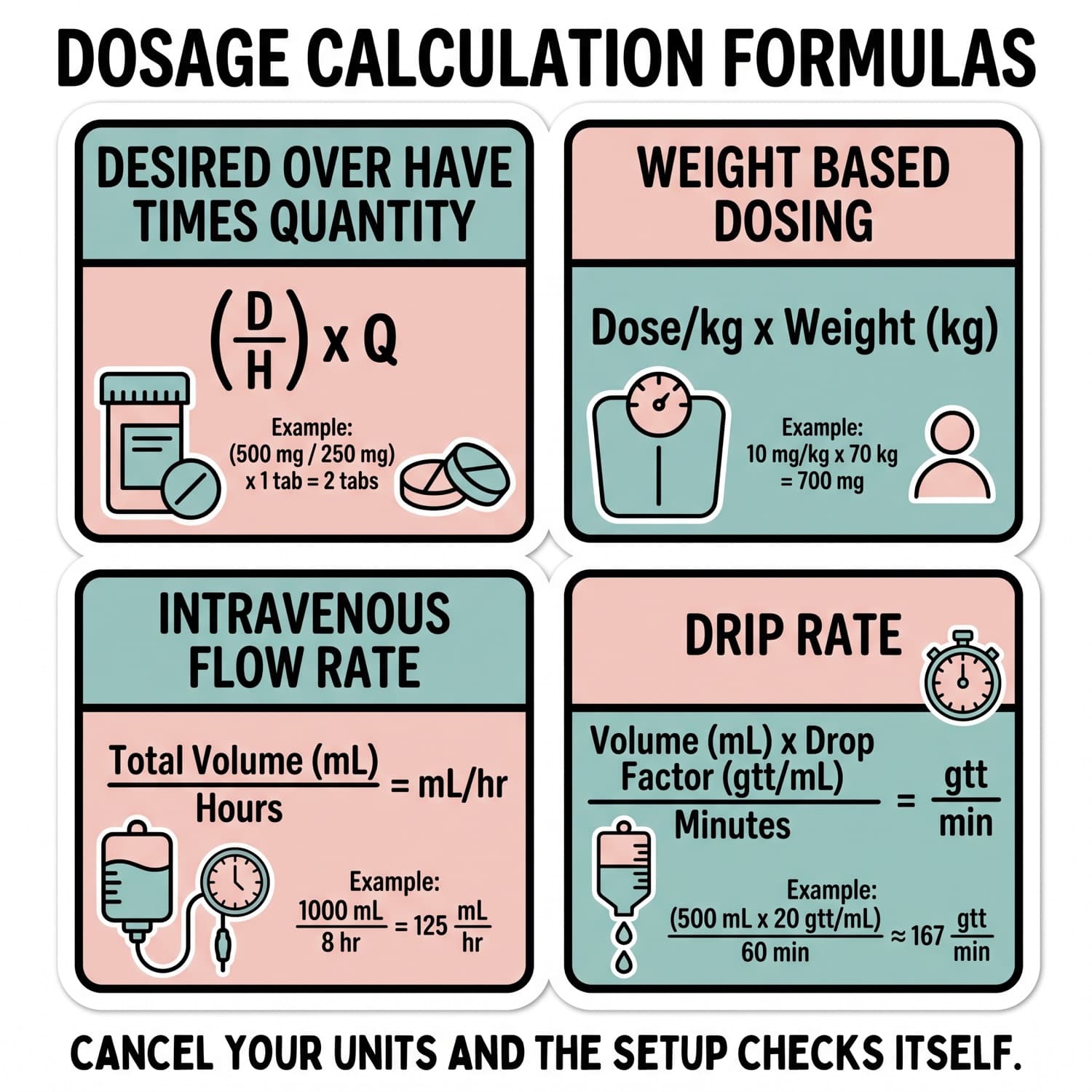
The argument
Every other method gives you an answer. Only this one tells you when the answer is impossible. You start from what you were given, you end at the unit the question wants, and every factor in between is an equality you already trust. If the labels refuse to cancel into the unit asked for, the setup is wrong and you have learned that before you touch the calculator.
The four moves
- Write the unit you want on the right of the equals sign. That is your destination.
- Write the given quantity on the far left. That is your start.
- Bridge with equalities, each one written so the unwanted unit sits opposite itself, one on top and one on the bottom.
- Cancel. Multiply across the top, divide across the bottom.
Worked problem
Order: cefazolin 750 mg intravenously. Supply: a 1 g vial reconstituted to 10 mL.
750 mg × (1 g / 1000 mg) × (10 mL / 1 g) = 7500 ÷ 1000 = 7.5 mL
Milligrams cancel against milligrams. Grams cancel against grams. Milliliters are the only label left standing, and milliliters is what the question asked for, so the setup is legal before the arithmetic runs.
Second worked problem
Order: gentamicin 60 mg intravenously. Supply: 40 mg/mL.
60 mg × (1 mL / 40 mg) = 60 ÷ 40 = 1.5 mL
The rejection drill
The same cefazolin order, set up inverted:
750 mg × (1000 mg / 1 g) × (1 g / 10 mL)
Milligrams do not cancel; they multiply. The surviving labels are milligrams squared over milliliters. That is not a volume, and no amount of arithmetic will make it one. Answer: reject the setup. Do not compute it.
Memory hookCURB — Cancel the units. Unit asked for is the unit left standing. Reasonable against the device that will hold it. Back-calculate into the original stem.
Watch outif the labels do not cancel, stop. Do not push through and hope the number looks right.
Margin notethe units are the proof; the number is only the last step.
Takeawaydimensional analysis is on the syllabus because it is the only method that announces its own errors.