
Sodium and Potassium, All Four Directions
| SODIUM 135–145 mEq/L · critical below 120 or above 160 mEq/L | POTASSIUM 3.5–5.0 mEq/L · critical below 2.5 or above 6.5 mEq/L | |
|---|---|---|
| PUSHES IT UP | Water loss, insufficient intake, hypertonic fluids | Renal failure, cell breakdown, acidosis, potassium-sparing therapy |
| PUSHES IT DOWN | Dilution, retention of water, diuretics, GI losses | GI and renal losses, insulin shifts, alkalosis |
| WHAT THE BODY DOES | Defends serum osmolality 275–295 mOsm/kg with thirst and antidiuretic hormone | Dumps or holds potassium at the tubule slowly, so shifts across the cell membrane outrun excretion |
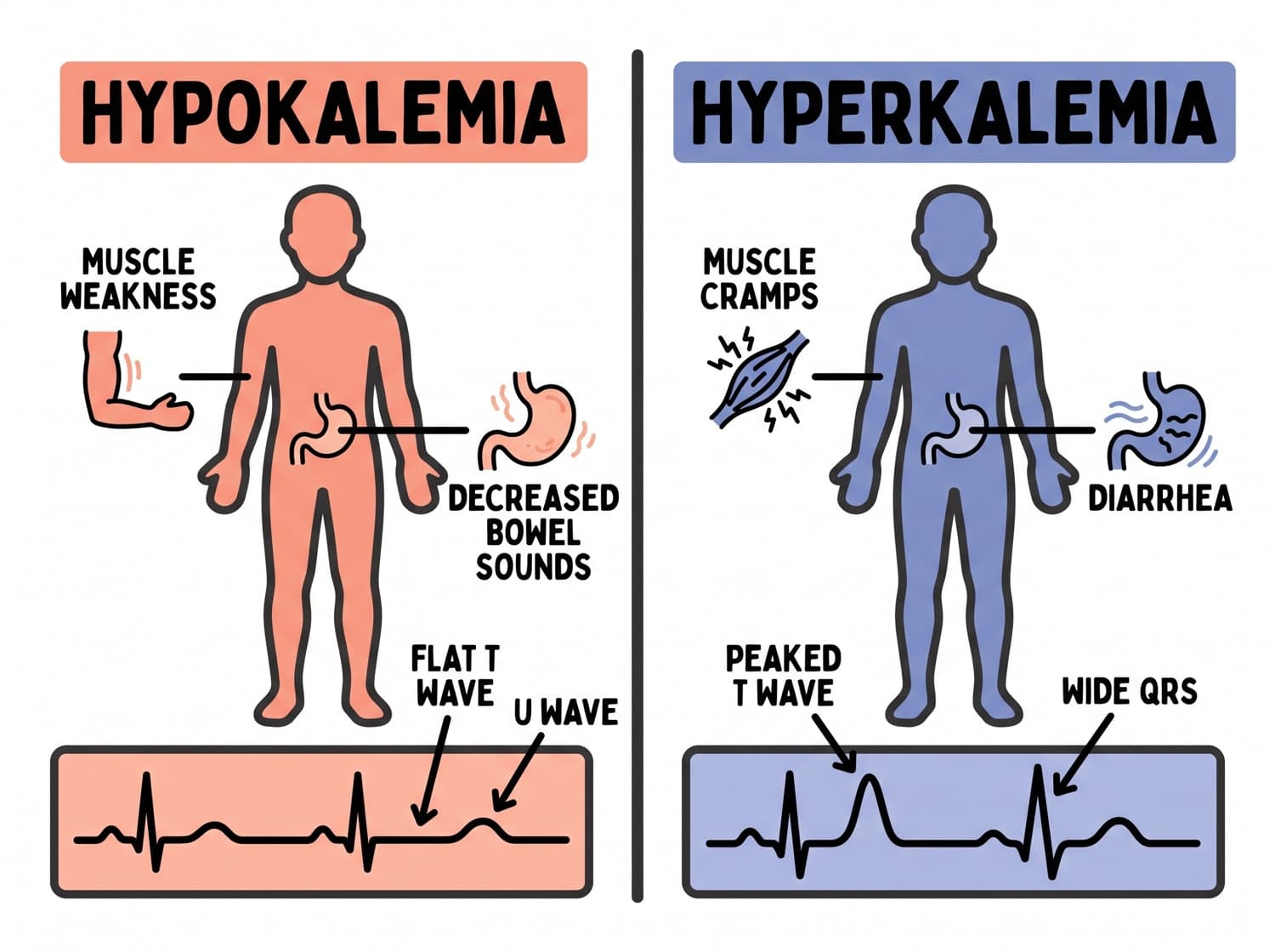
| WHAT YOU SEE | Neurologic change in both directions, because the brain moves water | The monitor changes first: peaked T waves and a widening QRS when high, flattened T waves and U waves when low |
| FIRST ACTION, HIGH | Assess neurologic status and volume, correct the volume before chasing the digit | Obtain an ECG, stop all potassium intake including diet, prepare to stabilize the myocardium |
| FIRST ACTION, LOW | Seizure precautions, hold free water, correct slowly, roughly no more than 8 mEq/L in 24 hours | Obtain an ECG, replace by the ordered route, and never push intravenous potassium |
| CRITICAL CALL | Below 120 or above 160 mEq/L: neuro check and seizure precautions, then call | Below 2.5 or above 6.5 mEq/L: ECG, then call |
Shadow row: chloride 98 to 106 mEq/L. Chloride follows sodium and moves opposite bicarbonate. Vomiting and gastric suction strip chloride out, bicarbonate climbs to fill the space, and a metabolic alkalosis follows.
Margin notesodium is a brain problem, potassium is a heart problem.
Watch outintravenous potassium is never given by push. It is always diluted and always infused. This is the single most repeated patient-harm item in the electrolyte set.
Memory hookHIGH AND TIGHT, LOW AND SLOW for potassium on the monitor. High potassium peaks the T wave and widens the QRS. Low potassium flattens the T wave and raises a U wave.
☐ I can name the first action in all four directions without looking.
→ BOOK 10 · P5 for the conditions that drive these shifts. → BOOK 06 · P9 for infusion rates and dilution math.
Takeawayfour directions, four first actions, and the first action is an assessment more often than a treatment.
Reference ranges and critical thresholds vary between institutions and reference laboratories. Follow local protocol.