One cue, then the cliff
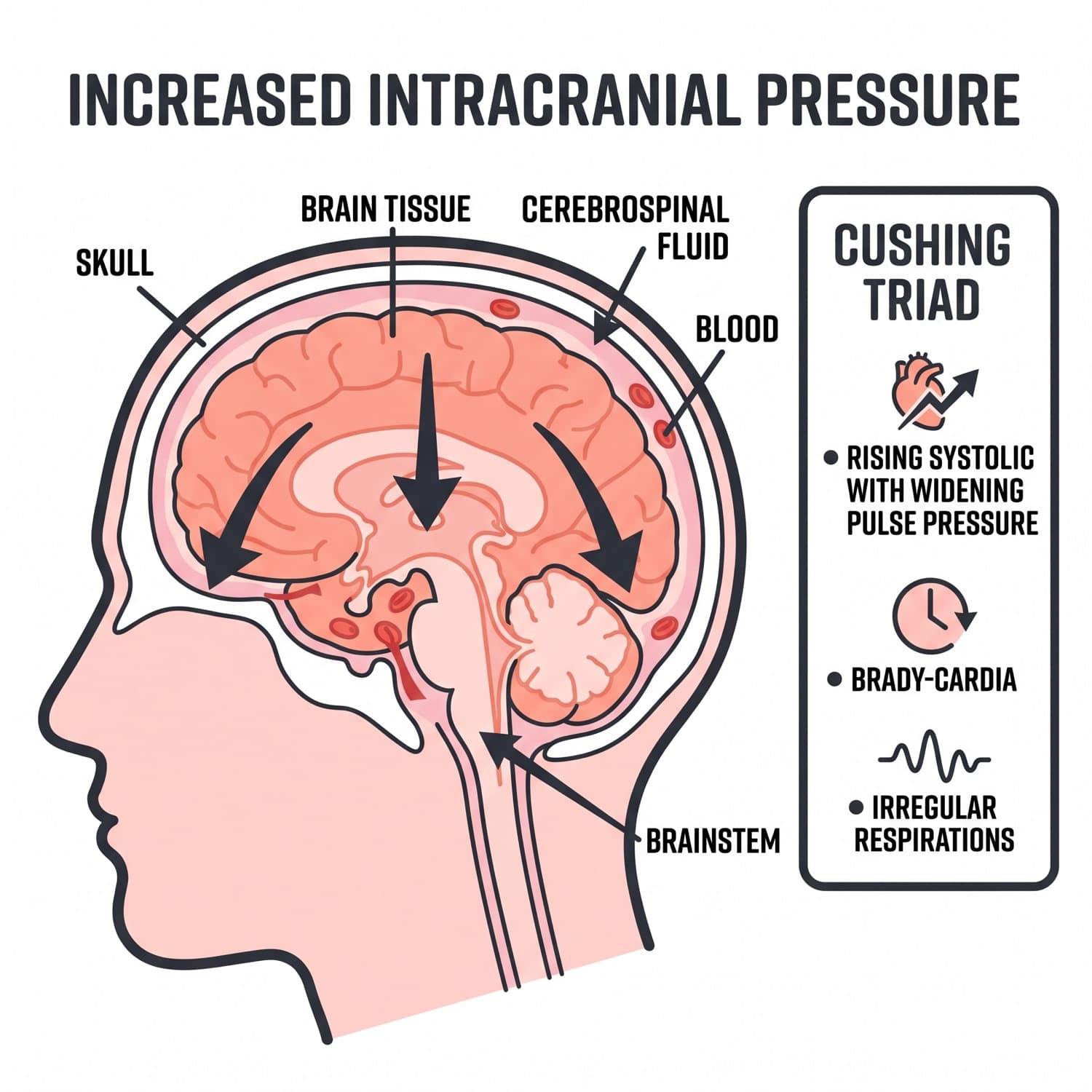
The argument. Three unrelated systems are bound into one book because they share one behavior. Each holds a reserve that hides deterioration for as long as the reserve lasts, so the patient looks stable while the problem grows underneath. When the reserve runs out, the decline is not gradual, it is a cliff. This is why the exam almost never shows you the collapse and asks what to do. It shows the quiet cue that comes before the collapse and asks whether you saw it. Restlessness before Cushing's triad. A creatinine that has moved off this patient's own baseline before anuria. A missed steroid dose before hypotension that will not answer fluid.
Panel 1 · The brain
- Reserve: displaceable cerebrospinal fluid and venous blood inside a vault that cannot expand.
- First cue: any change in level of consciousness, including a patient who is simply harder to rouse than an hour ago.
- Cliff: herniation.
Panel 2 · The kidney
- Reserve: nephron capacity that is not currently being used.
- First cue: urine output falling while the creatinine climbs off this patient's own baseline, even when the value is still inside the population reference range → BOOK 07 · P9.
- Cliff: uremia, fluid overload, and lethal hyperkalemia.
Panel 3 · The gland
- Reserve: stored hormone plus an intact feedback loop.
- First cue: a stressor arriving on top of a missed dose or an undertreated gland.
- Cliff: thyroid storm, myxedema coma, or adrenal crisis.
Memory hookRESERVE HIDES, THEN QUITS.
Margin notethey never show you the cliff, they show you the edge. Cue recognition as a method belongs to → BOOK 02 · P4.
Takeawayin all three systems the tested skill is naming the early cue, not managing the crisis.