
Question set A: the gut and the liver, ten items
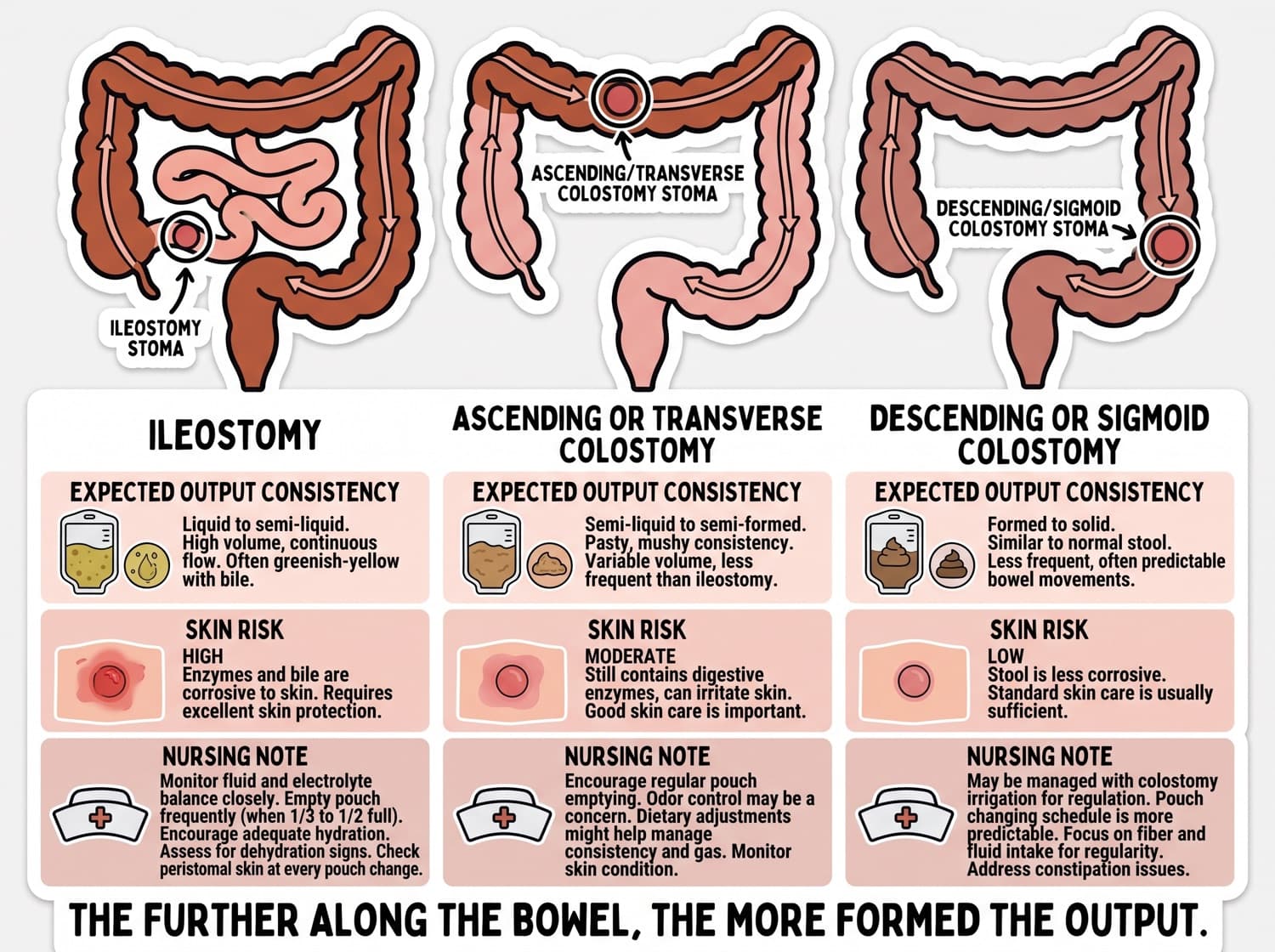
Ostomy output by site
| Ileostomy | Ascending colostomy | Transverse colostomy | Descending or sigmoid colostomy | |
|---|---|---|---|---|
| Consistency | Liquid to paste | Liquid to semi-liquid | Semi-formed, mushy | Formed |
| Volume | Highest | High | Moderate | Lowest |
| Enzyme content | High, digestive enzymes intact | Present | Low | Minimal |
| Peristomal skin risk | Highest | High | Moderate | Low |
| Irrigation an option | No | No | Generally no | Yes, for regulation |
A healthy stoma is beefy red and moist. A dusky, purple, or black stoma is reported immediately.
TIMING: 12 minutes
1. A 62-year-old reports coffee-ground emesis this morning and has just passed a black, tarry stool. Blood pressure 92/54, heart rate 118, skin cool. Which action does the nurse take first?
- Send a stool specimen for occult blood testing
- Establish large-bore intravenous access and begin the prescribed isotonic fluid
- Obtain a detailed dietary history from the previous week
- Place the patient in high Fowler position and offer clear liquids
2. A 70-year-old is passing bright red blood per rectum. Which finding most strongly suggests the bleeding source is proximal to the ligament of Treitz?
- Blood urea nitrogen rising while creatinine remains unchanged
- Tenderness in the left lower quadrant
- A documented history of internal hemorrhoids
- Mucus mixed through the stool
3. A patient with a known duodenal ulcer develops sudden severe epigastric pain and a rigid, board-like abdomen. Place the nurse's actions in order.
- Administer the prescribed intravenous antibiotic
- Obtain a full set of vital signs and assess the abdomen
- Insert the nasogastric tube to low intermittent suction as prescribed
- Keep the patient nothing by mouth and stop all oral and enteral intake
- Notify the surgeon
4. A 19-year-old with suspected appendicitis asks for a heating pad and a laxative because "nothing is moving." Which response is correct?
- Apply a warm compress to the right lower quadrant for comfort
- Administer the prescribed enema to relieve the constipation
- Keep the patient nothing by mouth and withhold heat, enemas, and laxatives
- Encourage ambulation with the knees fully extended
5. Which cluster best supports small bowel rather than large bowel obstruction?
- Gradual distension, obstipation, and late feculent vomiting
- Colicky pain, early bilious vomiting, and high-pitched bowel sounds
- Painless bright red rectal bleeding with normal bowel sounds
- Constant epigastric pain relieved by leaning forward
6. A patient admitted with acute pancreatitis develops carpal spasm when the blood pressure cuff is inflated. Select all that apply. Which actions are appropriate?
- Notify the provider of a positive Trousseau sign
- Initiate seizure precautions
- Document the finding as an expected effect of the cuff pressure
- Assess for facial twitching when the facial nerve is tapped
- Encourage the patient to lie flat to reduce pain
7. A patient with cirrhosis is being monitored on a medical unit. Select all that apply. Which findings require immediate provider notification?
- Hand flapping when the wrists are extended
- Reversal of the day and night sleep pattern beginning today
- One episode of coffee-ground emesis
- Abdominal girth unchanged from yesterday at the same landmark
- Blood pressure of 84/48 one hour after a large-volume paracentesis
8. An unvaccinated nurse sustains a needlestick from a patient known to be positive for hepatitis B surface antigen. Which post-exposure management does the nurse anticipate?
- Hepatitis B immune globulin plus initiation of the hepatitis B vaccine series
- Immune globulin alone, with no vaccine indicated
- Baseline and follow-up testing only, because no prophylaxis exists
- A single dose of hepatitis A vaccine
9. Hot spot. Using the figure above, mark the stoma site whose output is liquid, enzyme-rich, and highest in volume, and which therefore carries the greatest peristomal skin breakdown and dehydration risk. ☐ Ileostomy ☐ Ascending colostomy ☐ Transverse colostomy ☐ Descending or sigmoid colostomy
10. The patient in item 9 is being discharged. Select all that apply. Which statements indicate correct understanding?
- "I will cut the appliance opening about one eighth of an inch larger than my stoma."
- "I will empty the pouch when it is about one third full."
- "I will call if my output goes above about a liter a day or if I stop passing output and my abdomen cramps."
- "I will irrigate every morning to get on a schedule."
- "I will chew popcorn, nuts, and raw celery well for the first several weeks rather than avoiding them."
- "A little bleeding when I clean the stoma is expected, but a dusky or black stoma means I call right away."
☐1 ☐2 ☐3 ☐4 ☐5 ☐6 ☐7 ☐8 ☐9 ☐10
Margin noteanswer before you look at the figure twice.
Takeawaythe priority action is usually the one that stops a loss, protects an airway, or ends an exposure, and it is rarely the one that gathers more data.
Rationales → BOOK 11 · P13.