One Route, Every Patient: The Head-to-Toe Sequence
Why a fixed route
A route removes memory from the job. The nurse who improvises an order finds what caught the eye and misses what did not. Running the same path on every patient converts assessment from noticing into covering, and it produces a record another nurse can compare against tomorrow. A finding you did not walk past is a finding you did not rule out.
The three ordering rules
General survey and vital signs come first, because they set the frame for everything measured after them. The route runs from least invasive toward most invasive, and from clean areas toward soiled ones. Anything painful is examined last, because pain reorganizes the patient's cooperation and contaminates every finding that follows it.
The route, named
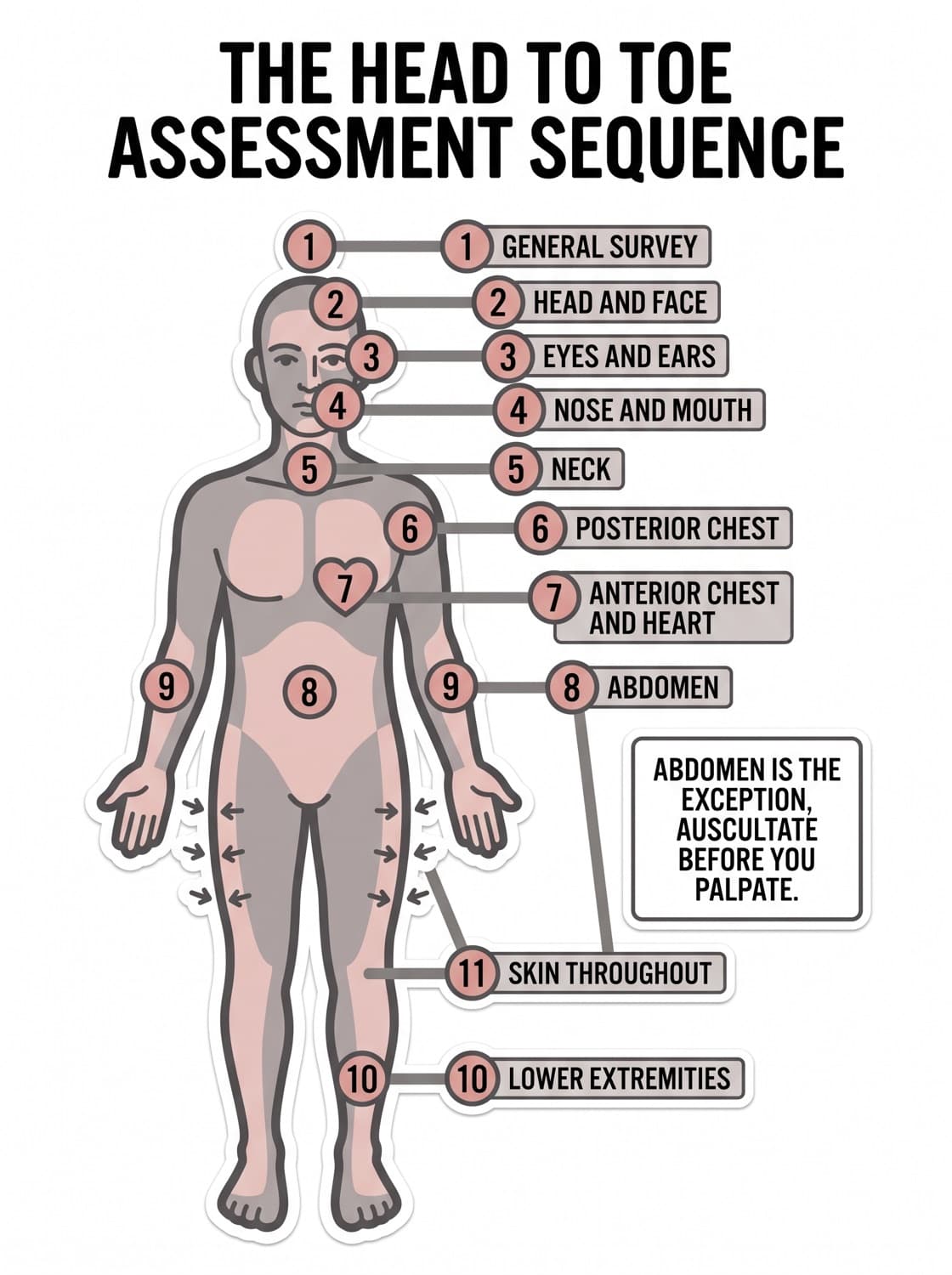
- 01 General survey — Normal: alert, appropriate, no distress. Abnormal: labored breathing at rest.
- 02 Vital signs — Normal: consistent with the patient's own baseline. Abnormal: a new drop on standing.
- 03 Head and face — Normal: symmetric, no lesions. Abnormal: new one-sided facial droop.
- 04 Eyes — Normal: pupils equal, round, reactive. Abnormal: one pupil newly larger and sluggish.
- 05 Ears — Normal: hears conversational voice. Abnormal: clear drainage after head trauma.
- 06 Nose — Normal: both nares patent, no drainage. Abnormal: nasal flaring at rest.
- 07 Mouth and throat — Normal: moist pink mucosa, uvula midline. Abnormal: tongue deviating to one side.
- 08 Neck and lymph nodes — Normal: trachea midline, nodes soft and mobile. Abnormal: a hard fixed node.
- 09 Thorax and lungs, posterior then anterior — Normal: symmetric expansion, clear sounds. Abnormal: crackles that do not clear with cough.
- 10 Heart — Normal: regular rate, apical matching radial. Abnormal: a newly irregular rhythm.
- 11 Peripheral vascular — Normal: pulses equal, refill brisk, no edema. Abnormal: a newly absent pedal pulse.
- 12 Abdomen — Normal: soft, non-tender, sounds in four quadrants. Abnormal: a firm distended abdomen. Order changes here.
- 13 Extremities and musculoskeletal — Normal: full range, equal strength. Abnormal: unilateral calf swelling and warmth.
- 14 Neurologic — Normal: oriented, follows commands, symmetric strength. Abnormal: new slurred speech.
- Skin, throughout — Normal: warm, dry, intact. Abnormal: non-blanchable redness over the sacrum.
- Genitourinary and rectal, last — Normal: no lesion or discharge. Abnormal: purulent discharge.
Where the route bends
In a child, auscultate the heart and lungs while the child is quiet, before anything invasive. In an emergency, airway, breathing, and circulation replace the route entirely. In a focused assessment, the route shrinks to the system in question and its immediate neighbors.
Memory hookTOP DOWN · CLEAN BEFORE DIRTY · QUIET BEFORE PAINFUL.
Margin noteyou don't find what you didn't walk past.
TakeawayThe same route every time is what turns assessment into coverage rather than into noticing.
Technique inside each stop → BOOK 15 · P4.