
Renal and endocrine rapid review: filters, circuits, and failing glands
PRERENAL AKI. The kidney is fine and the perfusion is not. Hemorrhage, dehydration, heart failure, or sepsis. Urine is scant and concentrated, because the nephron is still working and is holding onto everything it can. Exam hook: fix the volume and the kidney recovers.
INTRARENAL AKI. The tissue itself is damaged, most often by prolonged ischemia or by a nephrotoxin such as an aminoglycoside, a nonsteroidal anti-inflammatory drug, or radiographic contrast. Urine volume may be unremarkable, but the sediment carries muddy brown casts.
POSTRENAL AKI. Outflow is blocked, classically by prostatic enlargement or by stones. Bladder distention with anuria alternating with overflow dribbling is the giveaway. Exam hook: relieving the obstruction is the treatment.
THE FOUR PHASES. Onset. Then the oliguric phase, where fluid overload and rising potassium are what kill. Then the diuretic phase, where the danger flips to hypovolemia and potassium loss. Then recovery, over months.
CKD BEHAVIOR AND THE TRANSPLANTED KIDNEY. Chronic kidney disease brings anemia from lost erythropoietin, a rising phosphate with a falling calcium, metabolic acidosis, bone disease, and pruritus. In a transplant recipient, acute rejection announces itself as fever, tenderness over the graft site, falling urine output, weight gain, and a creatinine climbing off the patient's new post-transplant baseline. Exam hook: immunosuppression blunts the fever, so the subtle finding is the real one.
HEMODIALYSIS ACCESS. Palpate for a thrill and auscultate for a bruit every shift and after every treatment. No blood pressure cuff, no venipuncture, no intravenous line, and no constricting sleeve on that extremity. A new arteriovenous fistula needs weeks to months to mature, which is why a temporary catheter is used first.
DIALYSIS COMPLICATIONS. Hypotension and muscle cramping during treatment. Disequilibrium syndrome presents as headache, nausea, restlessness, and confusion when urea is cleared from the blood faster than the brain can equilibrate, and it is most likely during the first few treatments.
PERITONEAL DIALYSIS. Warm the dialysate with a dry warmer, never in a microwave. Effluent should return clear and pale yellow. Cloudy return is peritonitis until proven otherwise and is reported. Poor drainage is usually position, a kinked catheter, or constipation, checked in that order.
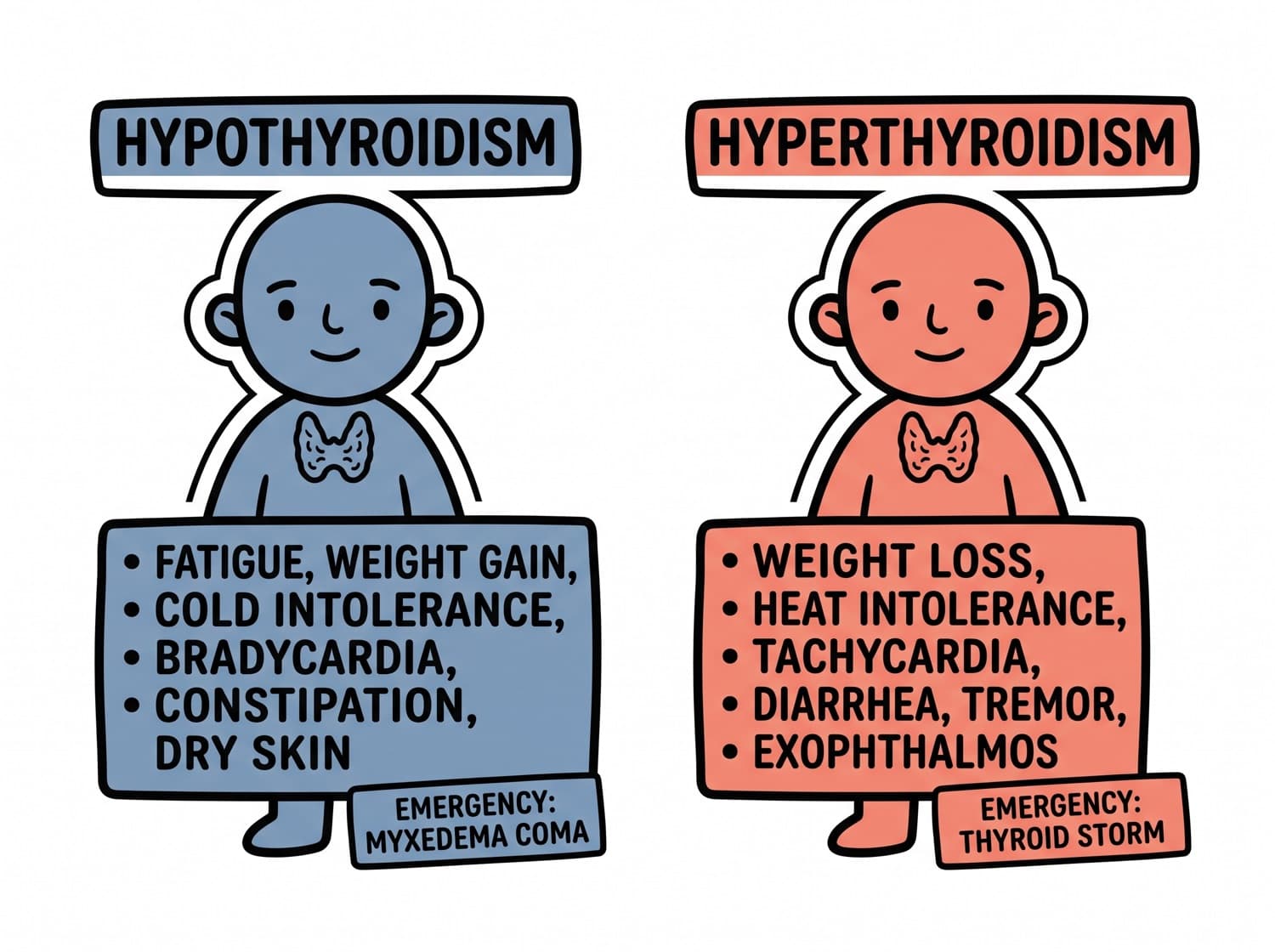
THE GLAND CRISES. Thyroid storm follows surgery, infection, or another stressor in an undertreated hyperthyroid patient, and presents as high fever, tachyarrhythmia, and agitated delirium; cooling measures are used without salicylates, which displace thyroid hormone from its binding proteins. Myxedema coma is the mirror image: hypothermia, bradycardia, hypoventilation with carbon dioxide retention, hyponatremia, and obtundation; rewarming is passive, because active external rewarming causes vasodilation and circulatory collapse. Adrenal crisis follows an abruptly stopped corticosteroid or an unmet stress demand, and presents as hypotension that does not answer fluid.
Memory hookCLOUDY MEANS CALL.
Margin notethe transplant patient without a fever is the one to worry about. Potassium, phosphate, and creatinine values are → BOOK 07 · P9. Sepsis physiology is → BOOK 09 · P5.
Takeawayrenal classification comes from the history, and each dialysis modality has exactly one cue that means stop and report.