
Delay is the mechanism: the harm page
AUTONOMIC DYSREFLEXIA · CRITICAL
Occurs in spinal cord injury at the sixth thoracic level or above. A noxious stimulus below the level of the injury triggers an unopposed sympathetic surge, and the correcting signal cannot travel back down past the lesion. The result is severe hypertension below the injury with reflex bradycardia above it.
Recognize it by: a pounding headache the patient will tell you about; a blood pressure far above that patient's own documented baseline, which in a person with a high cord injury is often low to begin with; a slow pulse; flushing and profuse sweating above the level of injury; pale, cool, goosefleshed skin below it; nasal congestion, blurred vision, and anxiety. The most common trigger is a distended bladder or a kinked catheter, then impacted stool, then anything pressing on skin, including a wrinkled sheet or a tight binder.
Watch out — first actions, in this order:
- Sit the patient fully upright and lower the legs. Gravity begins dropping the pressure immediately and this requires no order and no equipment.
- Loosen or remove every constricting garment, binder, abdominal support, and stocking.
- Check the blood pressure, then recheck it every 2 to 5 minutes until it is falling.
- Find and remove the stimulus, starting with the bladder. Check the catheter for kinks and for the bag position, then assess for retention, then assess for impacted stool.
- Notify the provider and anticipate a rapid-onset, short-acting antihypertensive if the pressure stays elevated after the trigger is removed.
Untreated, this ends in hemorrhagic stroke, seizure, retinal hemorrhage, or death. Exam hook: sitting up is a nursing action and it precedes everything.
RISING INTRACRANIAL PRESSURE AND HERNIATION · CRITICAL
Watch out — first actions, in this order:
- The finding that starts the clock is any decline in level of consciousness, including a patient who is merely harder to rouse than an hour ago. Do not wait for a second data point.
- Assess the airway and level of consciousness formally, and check the pupils. A new unilateral dilated pupil means herniation is in progress.
- Position: head of bed at 30 degrees, head midline, hips unflexed, and remove anything constricting the neck.
- Notify the provider immediately and stay with the patient.
- Keep stimulation minimal while you wait, and have suction and oxygen at the bedside.
Full mechanism is → BOOK 10 · P4.
STATUS EPILEPTICUS · CRITICAL. Continuous activity past 5 minutes is an airway emergency and a metabolic emergency, not simply a longer seizure.
HYPOGLYCEMIA · CRITICAL. Treat first, investigate afterward. Beta blockade masks the adrenergic warning signs, so a patient taking one may present with confusion alone. Verify the treatment threshold against the current ADA Standards of Care in Diabetes, since these targets are revised annually.
CEREBRAL EDEMA DURING GLUCOSE CORRECTION · WATCH. A patient whose mental status worsens while the glucose improves is decompensating, not recovering.
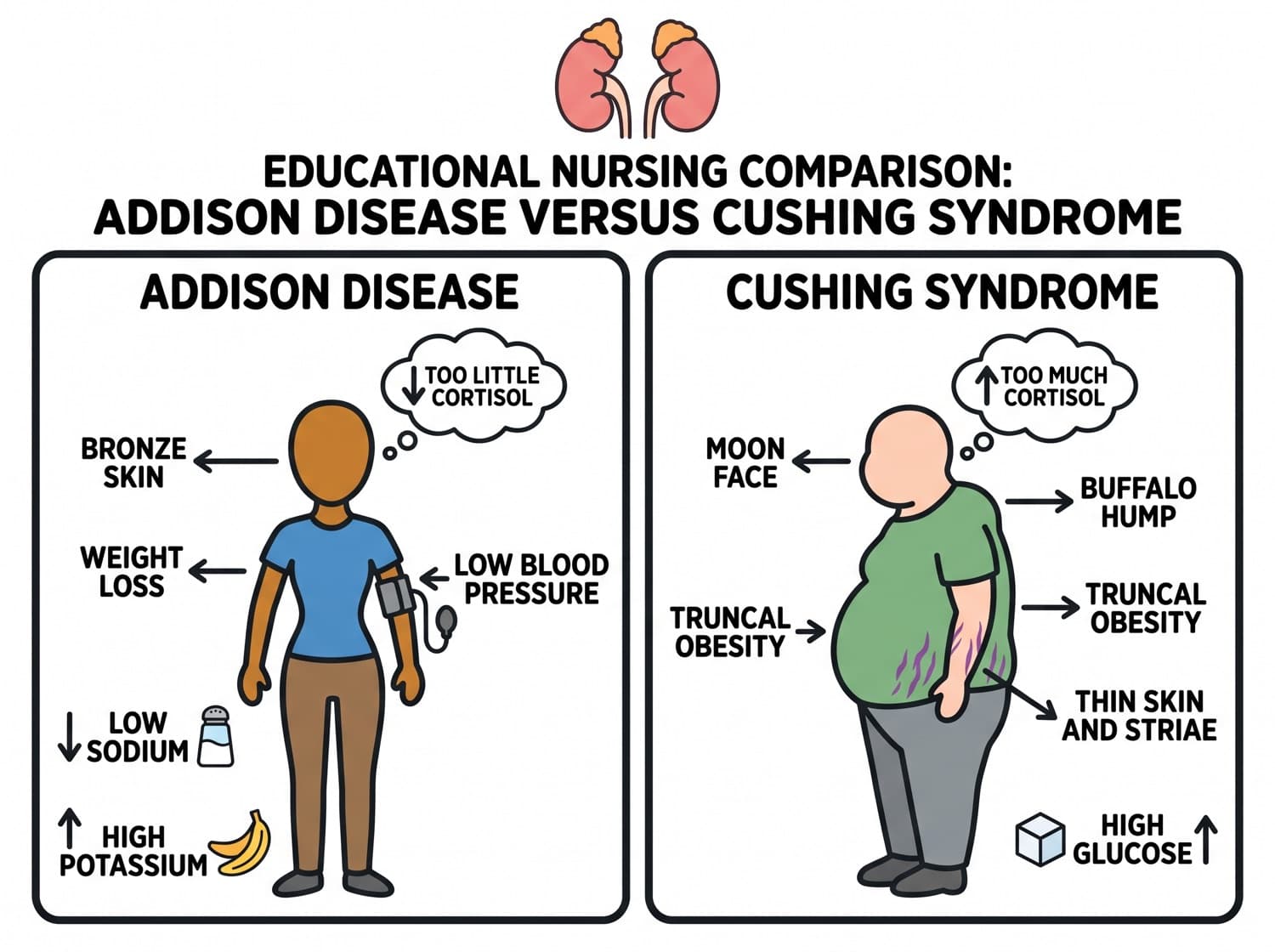
ADRENAL CRISIS AFTER A STOPPED STEROID · CRITICAL. Hypotension that does not answer a fluid bolus in a patient on chronic corticosteroids is adrenal crisis until disproven. Chronic corticosteroids are never stopped abruptly.
HYPERKALEMIA IN OLIGURIC AKI · CRITICAL. The rhythm changes before the patient feels anything → BOOK 07 · P9 and → BOOK 08 · P6.
Memory hookSIT, LOOSEN, LOOK.
Margin noteharder to wake up is a finding.
Takeawayon this page every death is caused by the interval between the cue and the nurse, and two of the seven can be reversed by an action that requires no order.