
Route First: The Only Question an Isolation Item Is Asking
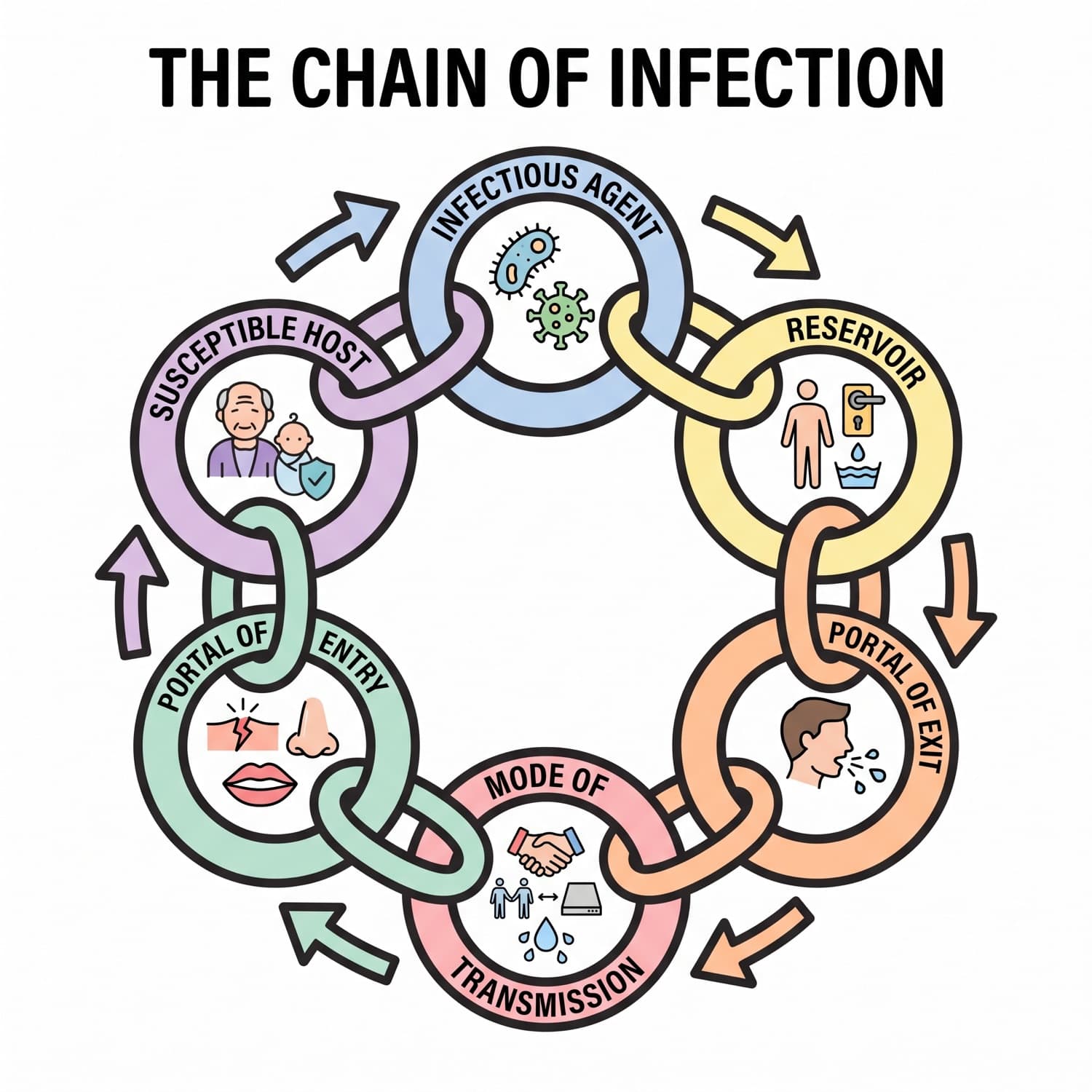
Standard precautions are the floor
They apply to every patient, every encounter, every time, because the diagnosis is usually unknown when care begins. They assume that blood, all body fluids except sweat, non-intact skin, and mucous membranes may carry something transmissible.
- Hand hygiene before and after every patient contact.
- PPE selected by anticipated exposure, not by diagnosis. Splash expected, wear eye protection. Contact with body fluid expected, wear gloves.
- Respiratory hygiene and cough etiquette: cover the cough, offer a mask and tissues at the point of entry, separate the coughing patient in waiting areas.
- Safe injection practice: one needle, one syringe, one time. Single-dose vials are not shared.
- Safe handling of contaminated equipment, linens, and environmental surfaces.
- A mask for the practitioner who places a catheter or injects material into the spinal canal or epidural space.
Transmission-based precautions are addition, never substitution
They are layered on top of standard precautions. Removing standard precautions because a category was added is a scoring error and a safety error. Two categories can apply at once. Varicella is the teaching case: it is airborne and contact, because the organism both stays suspended in air and lives on the lesions.
Act on the syndrome, not the culture
Empiric precautions go on before anything returns from the laboratory. The exam rewards the nurse who isolates on presentation.
- Undifferentiated cough with weight loss and night sweats is isolated as airborne during workup.
- Acute watery diarrhea in an adult recently on antibiotics is isolated as contact, with soap and water.
- A febrile child with an undiagnosed vesicular rash is isolated as airborne plus contact.
Memory hookThey hand you a bug and want a barrier.
Margin noteThe barrier follows the route, not the name of the organism.
TakeawayRoute determines barrier. The diagnosis is only the clue that reveals the route.
Verify at reprint: the elements of standard precautions, and the mask requirement for spinal and epidural procedures, against the current CDC/HICPAC Guideline for Isolation Precautions. Confirm the category names match the guideline's current wording exactly.