
Acute Kidney Injury
Sorted by where the problem sits relative to the kidney — before, within, or after. That location drives the entire management plan.
File
REN-05
- Read
- 9 min
- Alerts
- 3
- Actions
- 6
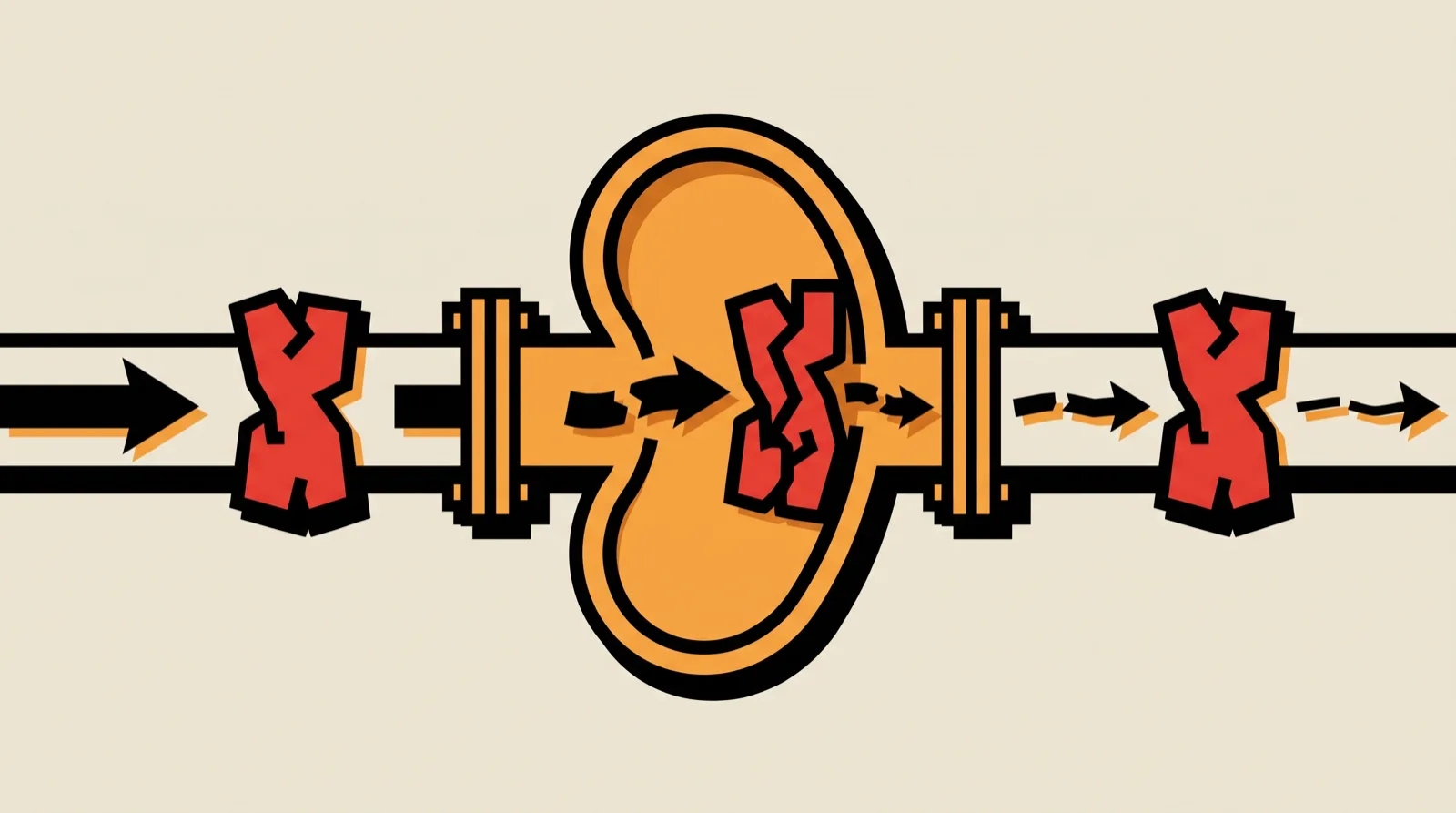
Hyperkalemia is the leading cause of death in oliguric AKI
CriticalThe failing kidney cannot excrete potassium. Monitor cardiac rhythm and escalate peaked T waves or a widening QRS immediately.
Reference values
0.6 – 1.2mg/dL
Rises only after substantial function is already lost, so a near-normal value can still hide injury.
10 – 20mg/dL
Rises with dehydration as well as kidney injury. Read it against creatinine, never alone.
> 20:1
< 400mL/day
Too little urine to clear the day's solute load. Expect potassium to climb and fluid to accumulate.
0.5mL/kg/hr
Below this, report it. Hourly output is the earliest bedside sign the kidneys are failing.
01Three categories, by location
Prerenal — the problem is before the kidney. Blood is not arriving. Hypovolaemia, haemorrhage, heart failure, shock. The kidney tissue itself is initially healthy, which is why prerenal AKI is the most reversible category if perfusion is restored quickly.
Intrarenal — the problem is within the kidney tissue. Acute tubular necrosis is the most common form, caused by prolonged ischaemia or nephrotoxins — aminoglycosides, IV contrast, NSAIDs.
Postrenal — the problem is after the kidney. Urine cannot get out. Prostatic enlargement, stones, tumours, a blocked catheter. Also highly reversible if the obstruction is relieved before back-pressure damages the tissue.
Always check the simple things first in a patient who stops producing urine. A kinked or obstructed catheter is postrenal AKI, and it resolves in seconds.
Plate AKI-01
Classification by location
Prerenal
- Hypovolaemia
- Haemorrhage
- Heart failure
- Shock
Intrarenal
- ATN
- Nephrotoxins
- Contrast
- Prolonged ischaemia
Postrenal
- Prostate
- Stones
- Tumour
- Blocked catheter
02The four phases
Onset — from the insult until urine output begins to fall.
Oliguric — output drops below roughly 400 mL/day. This is the dangerous phase: fluid overload, rising potassium, metabolic acidosis, and climbing nitrogenous wastes. Most complications occur here.
Diuretic — the tubules begin recovering but cannot yet concentrate urine. Output can rise dramatically, and the risk inverts: now the patient can become hypovolaemic and hypokalemic. The danger has not passed, it has changed direction.
Recovery — gradual return of function over weeks to months. Some patients do not return fully to baseline.
03What to watch
Creatinine is the more reliable marker of kidney function because it is produced steadily and is minimally affected by diet or hydration. BUN rises with dehydration, high protein intake, and GI bleeding, so it moves for reasons unrelated to the kidney.
The BUN-to-creatinine ratio helps localise the problem: a ratio above 20:1 points prerenal, because a dehydrated kidney reabsorbs urea avidly while creatinine handling changes little.
Hyperkalemia is the most immediately lethal complication of the oliguric phase — failing kidneys cannot excrete potassium. Cardiac monitoring is warranted.
Nutrition is adjusted rather than simply restricted: protein is moderated to limit nitrogenous waste while still supporting healing, with potassium, phosphate, and sodium limited according to labs.
The diuretic phase carries its own risk
WatchLarge urine volumes can produce hypovolaemia and hypokalemia. Do not assume rising output means the patient is out of danger.
Review every nephrotoxic agent
WatchAminoglycosides, NSAIDs, and IV contrast can cause or worsen intrarenal injury. Ensure adequate hydration around contrast studies.
Nursing actions
- 01Record strict hourly intake and output; report output under 30 mL/hr.
- 02Weigh daily — the most sensitive available measure of fluid balance.
- 03Rule out mechanical obstruction, including catheter patency, in any sudden anuria.
- 04Monitor potassium, creatinine, and acid–base status closely.
- 05Audit the medication list for nephrotoxins and review renal dosing.
- 06Maintain cardiac monitoring during the oliguric phase.
Sources
| Source | License |
|---|---|
| Open RN — Nursing Fundamentals / Pharmacology (CC BY 4.0)Informed scope and sequence. Prose written originally for this portal. | CC-BY-4.0 |
| MedlinePlus / NIH | Public Domain (US Gov) |