
Heart Failure
A pump that cannot keep up. Which side fails determines where the fluid backs up — and that one idea explains nearly every sign you will assess.
File
CAR-02
- Read
- 11 min
- Alerts
- 2
- Actions
- 6
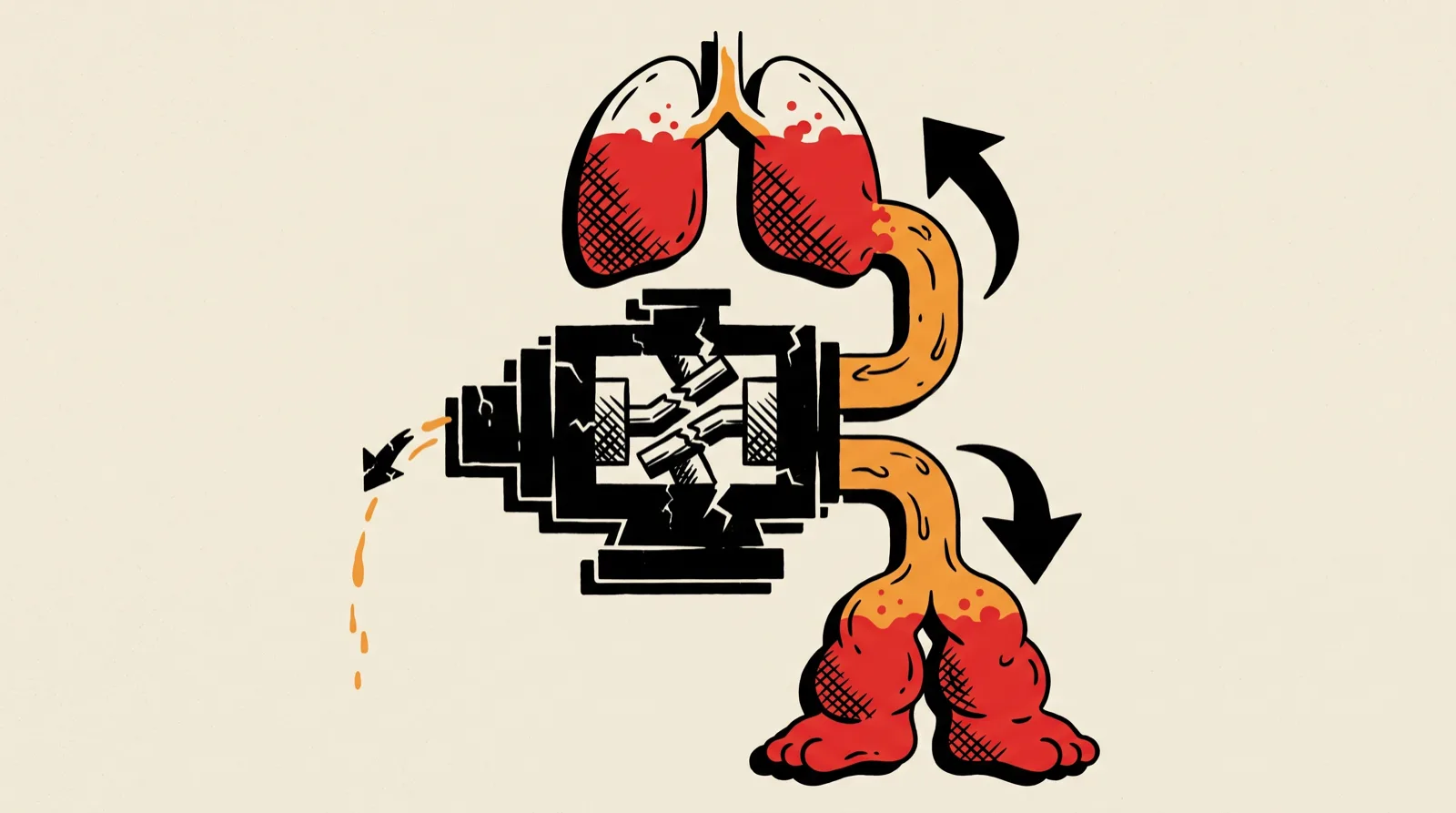
Pink frothy sputum is flash pulmonary edema
CriticalSit the patient upright with legs dependent, apply oxygen, and escalate immediately. This deteriorates within minutes.
Reference values
< 100pg/mL
Points away from heart failure as the cause of this patient's breathlessness. Look for another explanation.
> 400pg/mL
Released when the ventricle is stretched, so it tracks volume overload and falls as congestion resolves.
> 1 kg / day
Or 2.5 kg (5 lb) in one week
< 60bpm
Count a full minute at the apex before every dose. Hold and report rather than estimate from a radial pulse.
55 – 70%
The share of blood the left ventricle ejects each beat. Below 40% defines reduced-ejection-fraction failure.
01One principle, both sides
Heart failure is a pump problem, and fluid backs up behind the side that is failing. If you hold onto that single sentence you can reconstruct the entire symptom picture without memorising two separate lists.
The left ventricle sends blood to the body. When it fails, blood backs up behind it into the lungs. The right ventricle sends blood to the lungs. When it fails, blood backs up behind it into the body.
Plate HF-01
Direction of congestion
Left-sided failure
Backs up into — The lungs
- Crackles
- Orthopnea
- PND
- Pink frothy sputum
- S3 gallop
Right-sided failure
Backs up into — The body
- JVD
- Peripheral edema
- Hepatomegaly
- Ascites
- Weight gain
02Left-sided failure — the lungs fill
Everything here is respiratory:
- Dyspnea on exertion, progressing to dyspnea at rest
- Orthopnea — breathless lying flat, so the patient sleeps on extra pillows
- Paroxysmal nocturnal dyspnea — waking abruptly gasping a few hours into sleep
- Bilateral crackles that do not clear with coughing
- A persistent dry cough, and in severe decompensation pink frothy sputum
- S3 gallop
- Restlessness and confusion as cerebral perfusion drops
Pink frothy sputum means alveoli are filling with fluid. That is flash pulmonary edema and it is an emergency.
03Right-sided failure — the body swells
Everything here is systemic congestion:
- Jugular venous distension
- Dependent peripheral edema — ankles in a walking patient, sacrum in a bedbound one
- Hepatomegaly, ascites, and right upper quadrant fullness
- Weight gain, which appears before visible swelling
- Nausea and poor appetite from gut congestion
The most common cause of right-sided failure is left-sided failure. Over time the backed-up pressure in the lungs wears out the right ventricle too.
04Why daily weight beats everything else
Edema is a late sign. A patient can retain litres of fluid before you can see or press a mark into their ankle. The scale catches it days earlier.
One kilogram of weight gain equals roughly one litre of retained fluid. Weight is taken at the same time each morning, after voiding, in similar clothing, on the same scale.
Teach the patient the reporting threshold explicitly: more than 1 kg (2–3 lb) in a day, or 2.5 kg (5 lb) in a week, gets a phone call. That single habit prevents a large share of readmissions.
05Medications and what to watch
ACE inhibitors (-pril) reduce afterload. Watch for a persistent dry cough, hyperkalemia, and first-dose hypotension. A cough that will not settle is a common reason for switching to an ARB (-sartan).
Beta blockers (-olol) reduce workload long term but can worsen symptoms initially. Hold and reassess for bradycardia.
Loop diuretics such as furosemide pull fluid off quickly. Watch for hypokalemia, hypotension, and ototoxicity when given rapidly IV.
Digoxin strengthens contraction and slows rate. Take an apical pulse for a full minute and hold for a rate under 60. Early toxicity is easy to miss because it looks like ordinary malaise — nausea, anorexia, fatigue, and characteristically yellow-green visual halos.
Digoxin toxicity hides behind hypokalemia
WatchA low potassium increases myocardial sensitivity to digoxin. Toxicity can occur at a digoxin level within the therapeutic range.
Nursing actions
- 01Position upright — high Fowler's — to reduce venous return and ease work of breathing.
- 02Weigh daily at the same time, after voiding, before breakfast.
- 03Track strict intake and output; correlate with the weight trend, not against it.
- 04Auscultate lung fields and assess for JVD and dependent edema each shift.
- 05Teach sodium restriction and the specific weight threshold that triggers a call.
- 06Pace activity with planned rest periods to limit myocardial oxygen demand.
Sources
| Source | License |
|---|---|
| Open RN — Nursing Fundamentals / Pharmacology (CC BY 4.0)Informed scope and sequence. Prose written originally for this portal. | CC-BY-4.0 |
| MedlinePlus / NIH | Public Domain (US Gov) |