
Shock: the four types
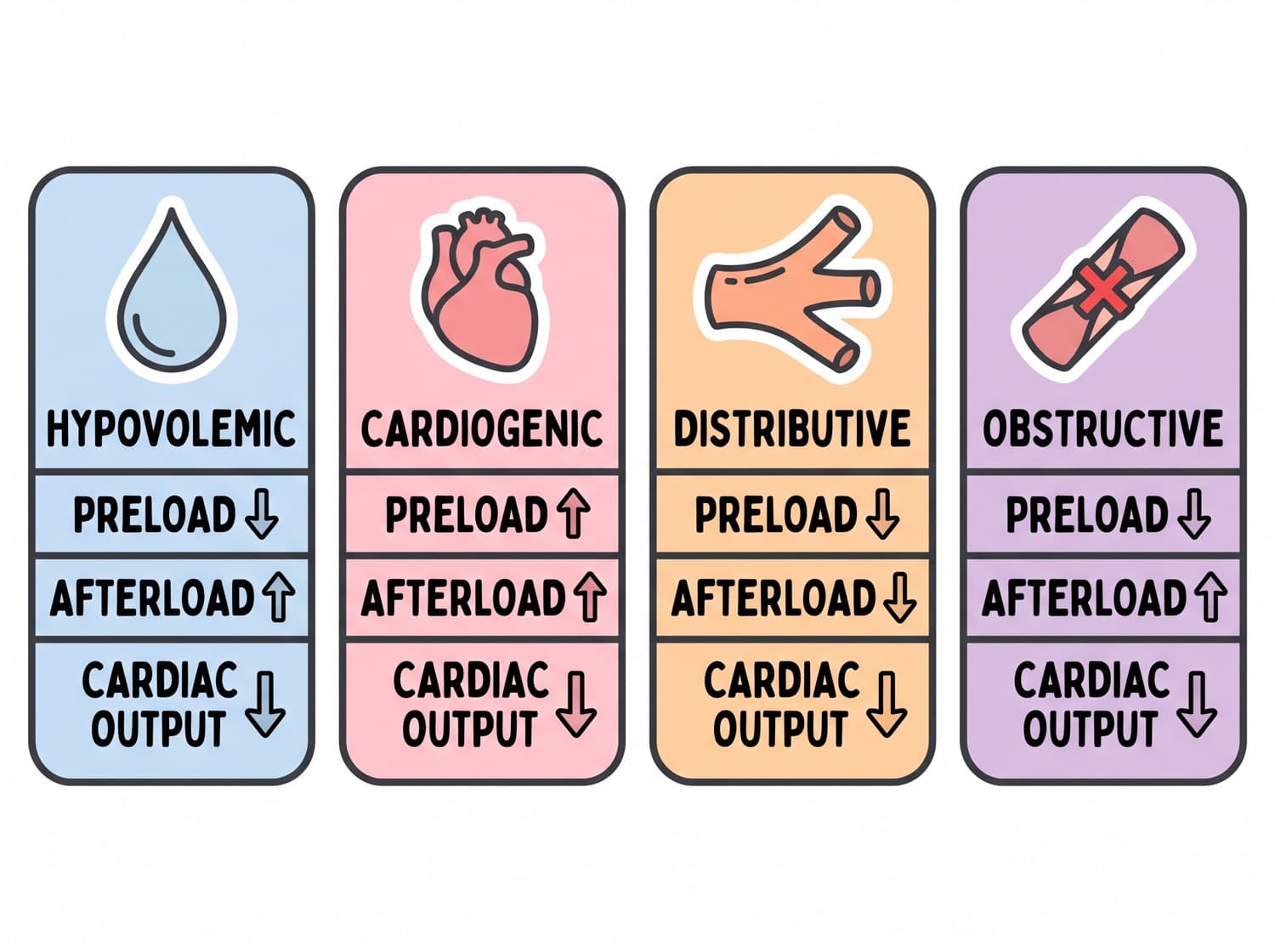
Shock is inadequate tissue perfusion. A closed circuit can fail in only four ways: the pump quits, the tank empties, the pipes dilate, or something blocks the flow. Name the break point and the intervention is already decided, which is why memorizing four unrelated syndromes is wasted effort.
| CARDIOGENIC | HYPOVOLEMIC | DISTRIBUTIVE | OBSTRUCTIVE | |
|---|---|---|---|---|
| Break point | The pump | The tank | The pipes | The outflow |
| Cause | Infarction, cardiomyopathy, severe dysrhythmia | Hemorrhage, burns, vomiting, diarrhea, third spacing | Sepsis, anaphylaxis, spinal cord injury | Tamponade, tension pneumothorax, massive pulmonary embolism |
| Preload | Up | Down | Down | Down at the ventricle despite high venous pressure |
| Resistance | Up | Up | Down | Up |
| Skin | Cool, clammy | Cool, clammy | Warm and flushed early, cold late | Cool, often with distended neck veins |
| Is fluid the answer? | No, it worsens pulmonary edema | Yes | Yes, alongside the specific treatment | No, relieve the obstruction |
The one that looks different
Distributive shock presents warm before it presents cold. Early sepsis shows a flushed patient with a widened pulse pressure and a bounding pulse, which reads as "not shocked" to an untrained eye. Neurogenic shock shows hypotension with bradycardia and warm, dry skin below the level of injury, the opposite of every other shock, because the sympathetic outflow that normally drives compensation has been cut.
Compensated is not stable
Blood pressure holds while heart rate rises, pulse pressure narrows, urine output falls, and mentation changes. The exam scores the candidate who acts in the compensated stage, not the one who waits for the systolic to fall.
Memory hookPump, Tank, Pipes, Block.
Margin notewarm and slow means spine, every time.
Watch outfluid boluses given to a patient in cardiogenic shock worsen pulmonary edema.
TakeawayFind the break point in the circuit and the first intervention follows without guessing.
→ BOOK 09 · P6 for full shock management · → BOOK 05 · P9 for the agents · → P40