
Skin: pressure injury staging and burn depth
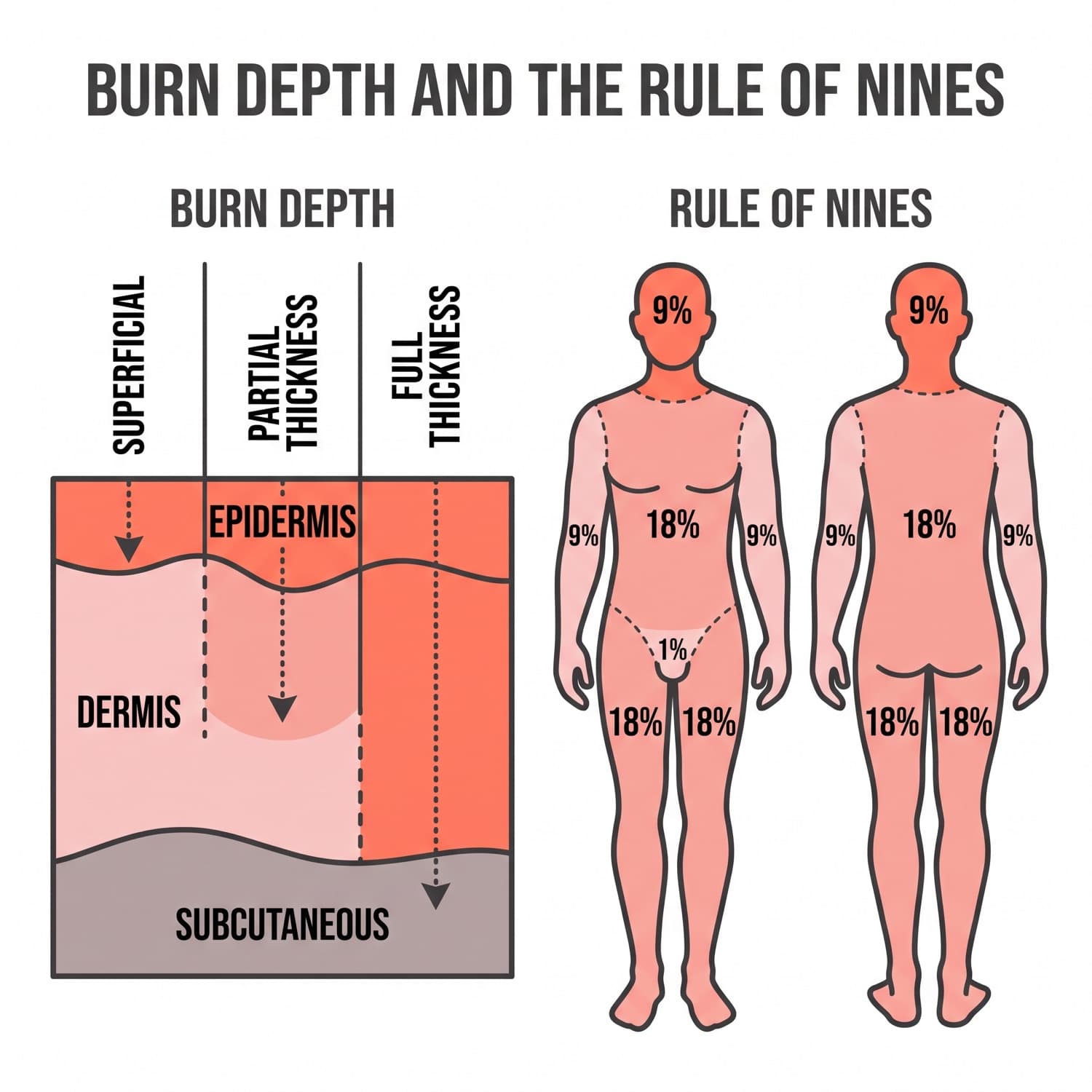
Two very different mechanisms, one grammar. Look for the deepest tissue you can actually see, name it, and both the stage and the plan follow. When you cannot see the base, you cannot stage it.
The stages in words
- Stage 1 — intact skin with localized nonblanchable redness. In darker skin tones look for a color change from surrounding skin, along with warmth, firmness, boggy texture, or pain.
- Stage 2 — partial-thickness loss of dermis presenting as a shallow open area with a pink-red base, or an intact or ruptured serum-filled blister. No slough, no fat visible.
- Stage 3 — full-thickness loss with fat visible in the wound. Undermining and tunneling may be present. Depth varies by body site.
- Stage 4 — full-thickness loss exposing muscle, tendon, ligament, cartilage, or bone.
- Unstageable — full-thickness loss in which the base is obscured by slough or eschar. Once the base is visible it will be a stage 3 or stage 4.
- Deep tissue pressure injury — persistent nonblanchable deep red, maroon, or purple discoloration of intact skin, or a blood-filled blister.
What not to do
- Do not stage a wound whose base you cannot see.
- Do not reverse-stage a healing wound. A healing stage 4 is a healing stage 4, not a stage 2.
- Do not massage a reddened bony prominence.
- Do not remove stable, dry, adherent eschar on an ischemic heel.
- Do not apply this staging system to mucosal injury.
Burns: the first priority
Airway comes before the wound, every time. Singed nasal hair, facial burns, soot in the mouth or sputum, hoarseness, or stridor after an enclosed-space fire mean airway swelling is coming, and early intubation is anticipated rather than delayed until distress appears. Then circulation and fluid, then thermoregulation, then the wound itself. A circumferential burn on a limb or around the chest threatens perfusion and ventilation mechanically, and is assessed as a compartment problem.
Margin noteif you cannot see the bottom, you cannot name it.
Watch outa hoarse voice after a fire in a closed space is an airway emergency before it is a skin problem.
TakeawayName the deepest visible structure, and both the pressure injury stage and the burn depth are already decided.
→ BOOK 15 · P9 for dressings and risk scales · → BOOK 06 · P11 for burn fluid calculations · → BOOK 04 · P7