
Exhibit: the anemia that is being destroyed, not lost
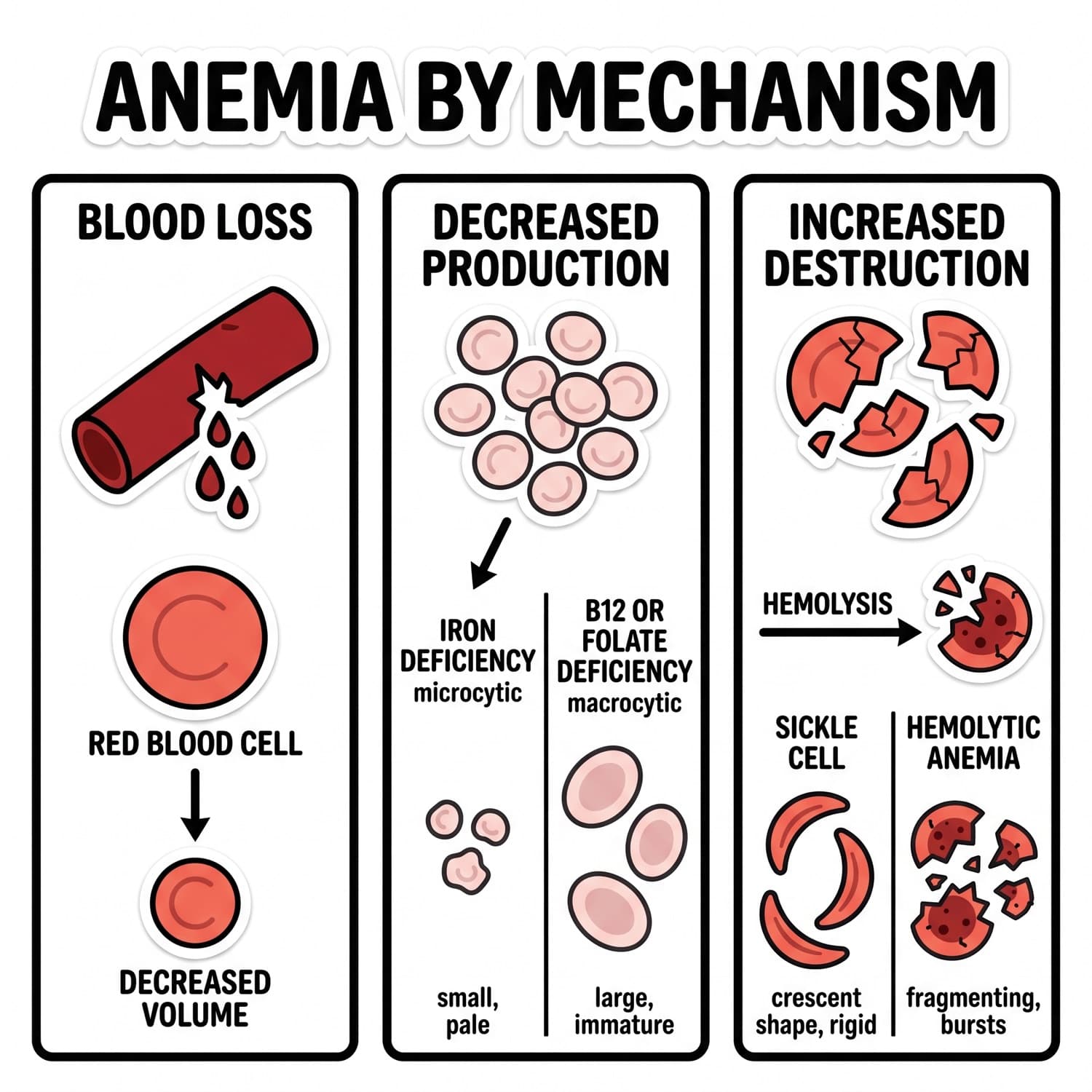
EXHIBIT — Tabs: Vital Signs · History and Physical · Laboratory Results · Provider Orders · Nurses' Notes
History and Physical 24-year-old with sickle cell disease. Third admission this year. Presents with severe bilateral leg and low back pain that began after a weekend outdoors in the cold with limited fluid intake. Reports the pain is like previous crises. Splenectomy at age 9.
Laboratory Results
| Today 0530 | Prior visit | |
|---|---|---|
| Hemoglobin | 7.4 g/dL | 7.6 g/dL |
| Hematocrit | 22 percent | 23 percent |
| Reticulocyte count | 12.4 percent | 9.8 percent |
| Lactate dehydrogenase | 648 units/L | 512 units/L |
| Total bilirubin | 3.4 mg/dL | 2.6 mg/dL |
| Indirect bilirubin | 2.9 mg/dL | 2.1 mg/dL |
| Haptoglobin | less than 10 mg/dL | 14 mg/dL |
| White blood cells | 14,200/mm³ | 9,800/mm³ |
| Platelets | 402,000/mm³ | 388,000/mm³ |
| Peripheral smear | sickled forms, target cells, Howell-Jolly bodies | sickled forms |
Vital Signs
| 0600 | 1000 | 1400 | |
|---|---|---|---|
| Temperature | 37.1 °C | 37.6 °C | 38.4 °C |
| Heart rate | 98 | 108 | 122 |
| Blood pressure | 118/68 | 112/64 | 104/58 |
| Respirations | 18 | 22 | 28 |
| Oxygen saturation | 97 percent, room air | 94 percent, room air | 89 percent, room air |
| Pain score | 9 of 10 | 8 of 10 | 8 of 10 |
Nurses' Notes — 1355 "Patient now reports discomfort across the chest, worse with a deep breath, with a dry cough that started this afternoon. Declined incentive spirometry twice this shift because of leg pain."
Provider Orders Isotonic intravenous fluid at a maintenance rate. Scheduled opioid analgesia around the clock with breakthrough dosing. Incentive spirometry every hour while awake. Oxygen titrated to saturation.
Anemia by mechanism
- Loss. Acute bleeding is normocytic at first; chronic bleeding drains iron and trends toward small, pale cells.
- Decreased production. Iron, vitamin B12, and folate deficiency, marrow failure, and the low erythropoietin of chronic kidney disease. Only B12 deficiency brings neurologic signs, and that is how it separates from folate deficiency.
- Increased destruction. Sickle cell disease, autoimmune hemolysis, and transfusion reaction. Reticulocytes rise, lactate dehydrogenase and indirect bilirubin rise, and haptoglobin falls because it is consumed binding free hemoglobin.
Watch outfever, chest pain, and a falling oxygen saturation in sickle cell disease is acute chest syndrome, the leading cause of death in this population. It is escalated immediately, not managed as worsening pain.
Margin notenever ice a sickle crisis; cold causes the sickling.
Howell-Jolly bodies confirm functional asplenia, which is why any fever in this patient is treated as high risk. Meperidine is avoided for crisis pain because its metabolite accumulates and lowers the seizure threshold.
Takeawaya high reticulocyte count with high lactate dehydrogenase, high indirect bilirubin, and low haptoglobin means the cells are being destroyed, and in this patient the chest findings now outrank the pain.
Every value's reference range → BOOK 07 · P6. Pediatric splenic sequestration → BOOK 13 · P8. Opioid pharmacology → BOOK 05 · P6.