
Red flags: the oncologic emergencies
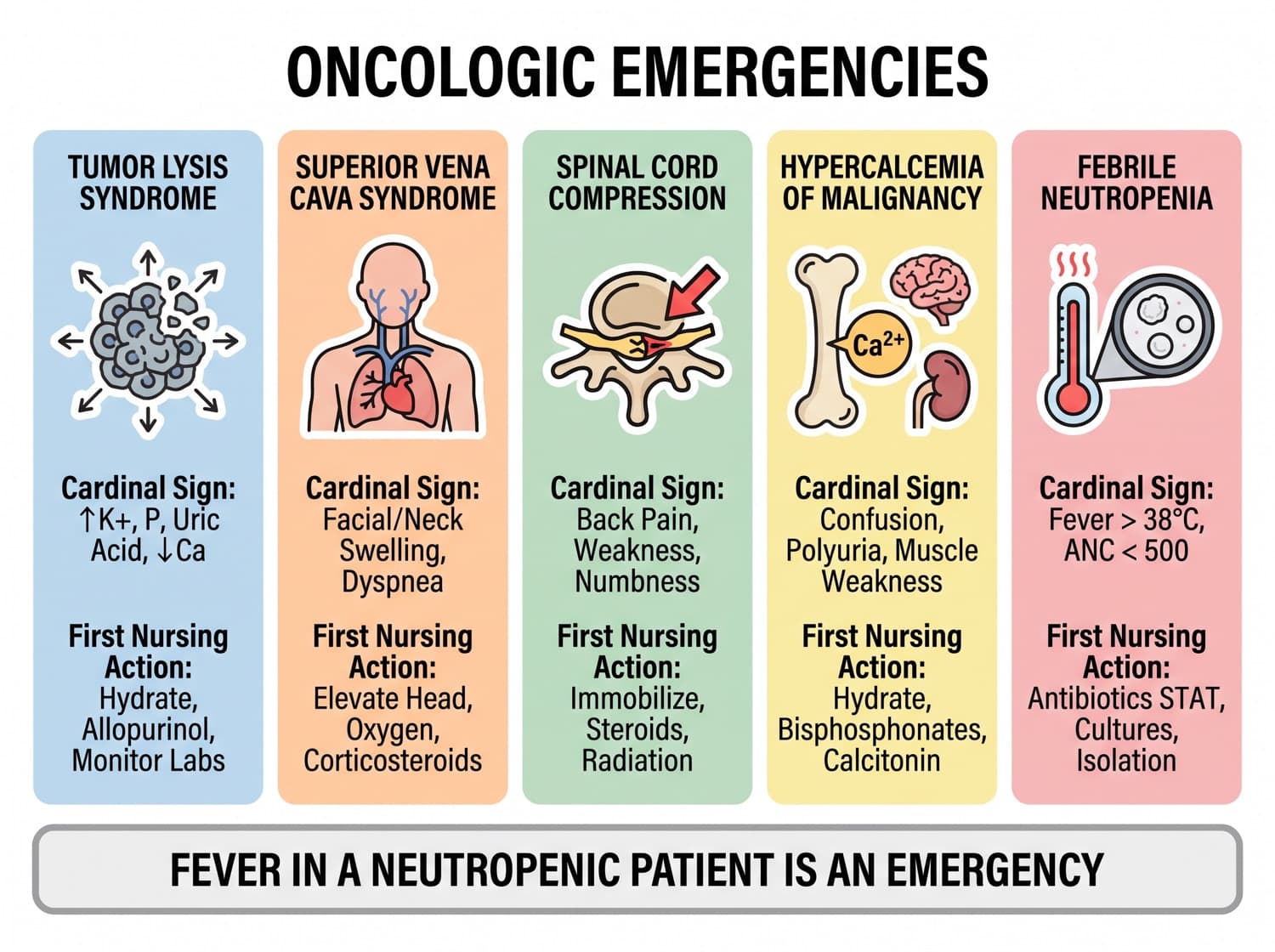
Febrile neutropenia — minutes to one hour
In a patient whose absolute neutrophil count is profoundly low, a single fever may be the only sign of infection, because the cells that make pus are gone. There will be no redness, no purulence, no infiltrate. Blood cultures first, then broad-spectrum antibiotics within one hour of the fever. Giving an antipyretic first hides the only cue there is. No rectal temperatures, suppositories, or enemas.
Tumor lysis syndrome — twelve to seventy-two hours after therapy
Bulky, fast-turnover disease dies all at once and spills its contents. Potassium, phosphate, and uric acid rise while calcium falls. The potassium is what kills, by arrhythmia. Aggressive hydration, the prescribed uric-acid lowering agent, scheduled chemistries, continuous cardiac monitoring.
Spinal cord compression — same shift, and sooner if weakness appears
Back pain comes first and often worsens lying flat, which is backwards for a muscle strain. Weakness follows. Bowel or bladder change is late and frequently permanent. New back pain in a patient with known cancer is imaged, not massaged. Corticosteroid and urgent imaging are the path.
Superior vena cava syndrome — same shift, escalating with the airway
Facial, neck, and upper extremity swelling with distended chest veins, worse when bending forward or lying flat, with hoarseness and dyspnea. Raise the head of the bed. Avoid upper extremity venous access and blood pressure cuffs on the affected side. Watch the airway.
Hypercalcemia of malignancy — same shift
Lethargy, confusion, constipation, polyuria, and weakness in a patient with bone metastases or myeloma. Isotonic saline hydration first, then the agents that drive calcium back into bone. Fall and confusion precautions belong in the same breath.
Vesicant extravasation — immediate
Burning, swelling, or loss of blood return during a vesicant infusion. Stop the infusion. Leave the catheter in place and aspirate residual drug. Notify. Apply the temperature and the antidote that the specific agent requires. Elevate, photograph, document.
Chemotherapy and radiation nursing, the floor rules
- Counts fall to their nadir roughly seven to fourteen days after a dose. That week is when fever means emergency.
- Mucositis care is a soft brush, saline or sodium bicarbonate rinses, and no alcohol-containing mouthwash.
- Radiation skin care over the treatment field: mild soap and water, pat dry, no lotions, powders, or heat, no sun exposure, and do not scrub off the field markings.
- Cytotoxic agents are handled with the facility's closed system, gown, and double gloves, and disposed of as cytotoxic waste. Body fluid handling precautions continue after treatment for the interval policy sets.
Memory hookTHREE UP, ONE DOWN for tumor lysis chemistry. Potassium, phosphate, and uric acid up; calcium down.
Margin noteback pain in cancer is never just back pain.
Takeawaythese emergencies mostly announce themselves with a symptom that sounds ordinary, and the clock starts at recognition, not at diagnosis.
Potassium, phosphate, uric acid, and calcium values → BOOK 07 · P4. Neutropenic precaution mechanics → BOOK 04 · P7. The arrhythmias hyperkalemia produces → BOOK 08 · P6.