
Which Way Does the Blood Shunt: Left to Right Versus Right to Left
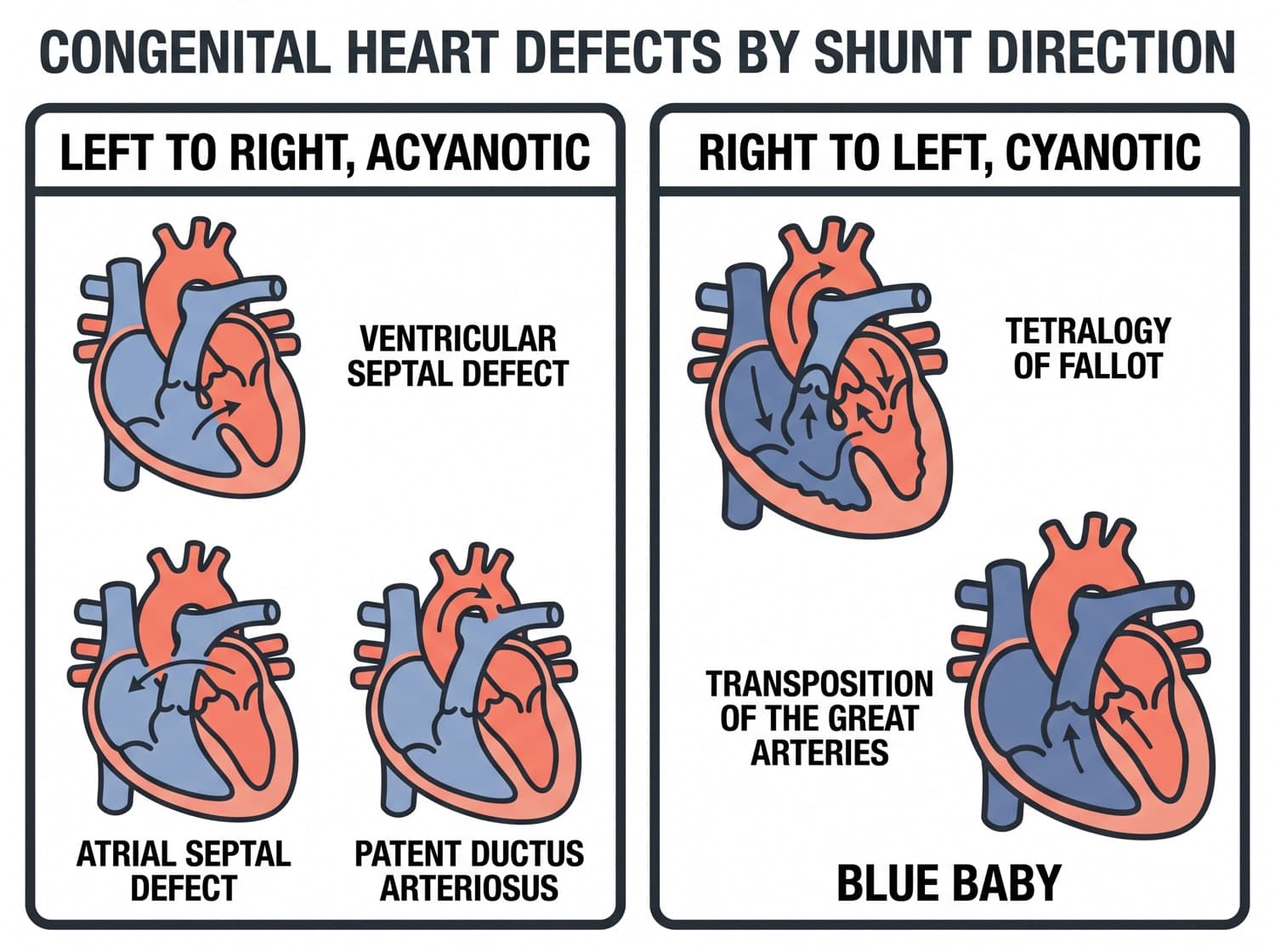
| LEFT TO RIGHT | RIGHT TO LEFT crit | |
|---|---|---|
| Direction | Oxygenated blood is pushed back into the pulmonary circuit | Deoxygenated blood bypasses the lungs and enters the systemic circulation |
| Result | Increased pulmonary blood flow; the child is acyanotic | Decreased effective pulmonary flow; the child is cyanotic |
| Defects | Atrial septal defect, ventricular septal defect, patent ductus arteriosus, atrioventricular canal defect | Tetralogy of Fallot, transposition of the great arteries, tricuspid atresia, truncus arteriosus, total anomalous pulmonary venous return |
| What the parent reports | The infant tires and sweats during feeds, takes forty minutes with a bottle, falls asleep before finishing | Blue spells with crying, feeding, or a bowel movement; the toddler squats during play |
| What you see | Tachypnea, murmur, hepatomegaly, periorbital edema, poor weight gain across the growth chart | Cyanosis not relieved by supplemental oxygen, clubbing in the older child, polycythemia |
| The emergency | Heart failure | The hypercyanotic spell |
| Nursing priority | Cut the work of feeding: small frequent feeds, soft or enlarged nipple, a rest partway through, upright positioning, daily weight on the same scale at the same time | Interrupt the spell in order, then prevent the next one: cluster care, avoid prolonged crying, keep the child well hydrated |
The hypercyanotic spell, in order crit
- Place the infant in a knee-to-chest position, or allow the toddler to squat.
- Calm the child. Use a quiet voice and let the caregiver hold them; agitation worsens the shunt.
- Administer supplemental oxygen.
- Notify the provider and prepare for further intervention.
Knee-to-chest raises systemic vascular resistance, which pushes blood back across the defect toward the lungs. Calming lowers oxygen demand. Oxygen helps only after flow is restored, which is why it is third and not first. This ordered response is the most frequently tested sequencing item in pediatric cardiac content.
Tetralogy of Fallot is four findings: ventricular septal defect, pulmonary stenosis, an overriding aorta, and right ventricular hypertrophy. The pulmonary stenosis is what makes it cyanotic; the degree of stenosis predicts how blue the infant is.
Obstructive footnote watch Coarctation of the aorta is neither shunt. It is a narrowing of the aorta, and it announces itself as bounding pulses and higher blood pressure in the arms with weak or absent femoral pulses and cooler legs. Always compare upper and lower extremity pulses in an infant with a murmur.
Memory hookthe five cyanotic T's — Tetralogy of Fallot, Transposition of the great arteries, Tricuspid atresia, Truncus arteriosus, Total anomalous pulmonary venous return.
Margin noteblue means right to left. Everything else follows from the arrow.
Takeawaydirection first, defect second; the direction predicts the whole picture. → BOOK 08 · P3