
Croup, Epiglottitis, and Bronchiolitis: Three Noisy Airways, One You Never Look At
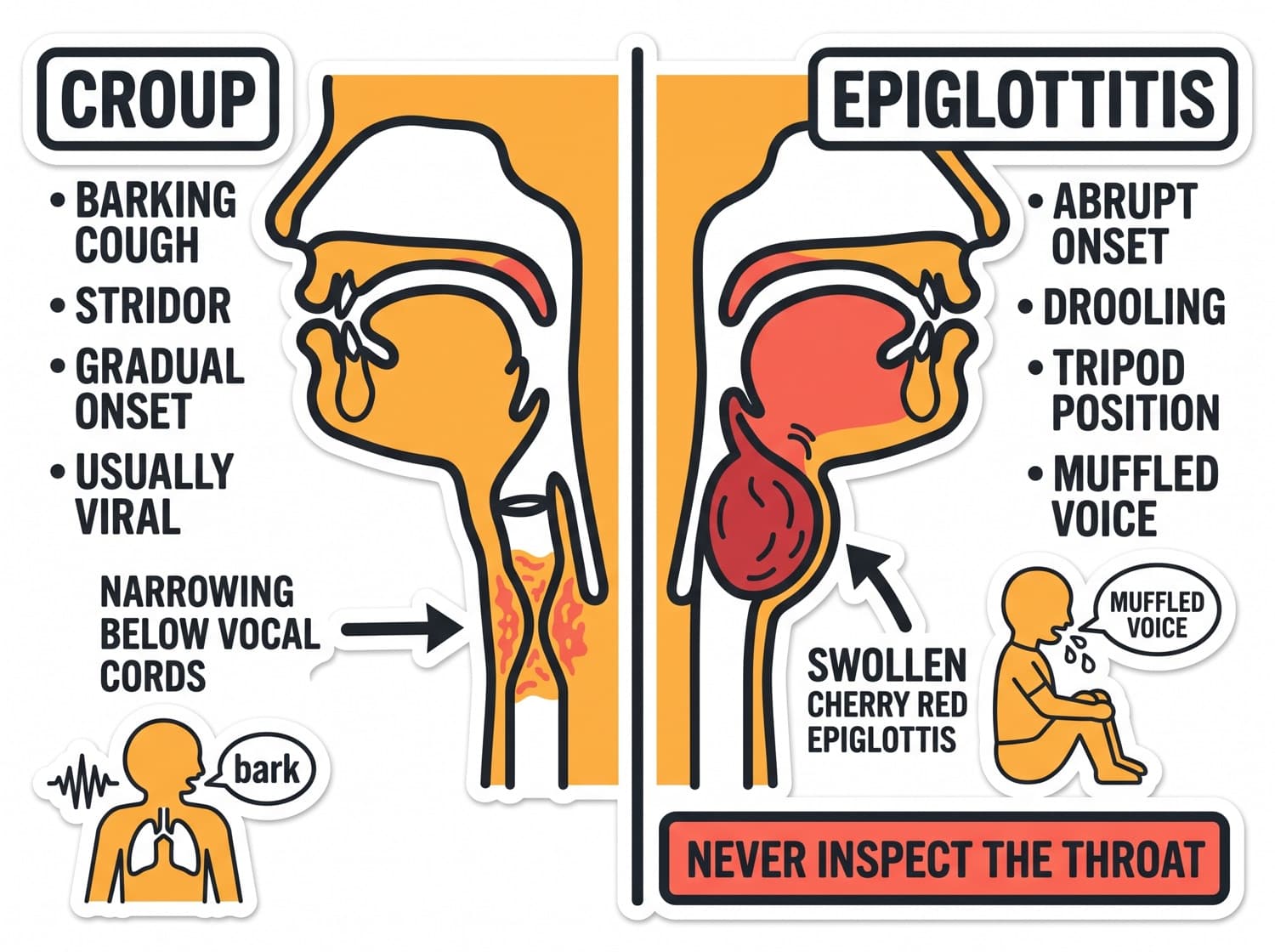
| CROUP | EPIGLOTTITIS crit | BRONCHIOLITIS | |
|---|---|---|---|
| Typical age | 6 months to 3 years | Any age; classically 2 to 7 years | Under 2 years, peak in early infancy |
| Onset | Gradual over a day or two, worse at night | Abrupt, over hours | Gradual after upper respiratory symptoms |
| Cause | Viral, usually parainfluenza | Bacterial | Respiratory syncytial virus most often |
| Cough | Barking, seal-like | Absent | Wet, with wheeze |
| Voice | Hoarse | Muffled, "hot potato" | Normal |
| Drooling | No | Yes, with painful swallowing | No |
| Posture | Any; comfortable | Tripod, chin thrust forward, still and quiet | Any |
| Fever | Low grade | High | Low grade |
| Sound | Inspiratory stridor | Inspiratory stridor with muffled voice | Expiratory wheeze and crackles |
| Imaging sign | Steeple sign on the frontal neck film | Thumb sign on the lateral neck film | Hyperinflation |
| What you do | Humidified air, corticosteroid, nebulized epinephrine when stridor is present at rest, keep the child calm | Keep upright in the caregiver's lap, keep calm, nothing by mouth, stay at the bedside, summon the airway team, intubation and tracheostomy equipment at the bedside | Suction the nares before feeds and sleep, saline drops, support hydration, elevate the head, monitor for apnea in the young infant |
| Throat examination | Permitted | Forbidden | Permitted |
The never-do list in suspected epiglottitis crit
- Never inspect the throat.
- Never insert a tongue blade.
- Never obtain a throat culture or any oral specimen.
- Never lay the child supine.
- Never leave the child unattended.
- Never force the child to lie down for imaging or an intravenous start.
Every one of those actions can trigger complete laryngospasm and total airway obstruction in a child whose airway is already narrowed to a slit. The correct order is calm, upright, and airway team. Anything that makes the child cry makes the airway smaller.
The classic bacterial cause is Haemophilus influenzae type b, which is why routine Hib immunization has made epiglottitis uncommon and why an unimmunized or under-immunized child changes the probability in the stem.
Bronchiolitis precautions. Contact precautions, with droplet precautions added per facility policy. Respiratory syncytial virus survives on surfaces and hands, so hand hygiene between infants is the single highest-yield action. Immunoprophylaxis exists for eligible infants and the eligible group is redefined periodically; verify the current AAP and CDC recommendation rather than recalling one. → BOOK 04 · P7
Margin notedrool plus tripod equals hands off the throat. Watch out: a child with epiglottitis who suddenly looks calm and stops struggling may be tiring, not improving. Silence in an obstructed airway is deterioration.
Takeawaya barking cough is croup and you may look; drooling with a quiet tripod child is epiglottitis and you may not. → BOOK 09 · P3