
When minutes are the treatment
WHEN MINUTES ARE THE TREATMENT
PANEL 1 · UMBILICAL CORD PROLAPSE crit
Cue. A sudden prolonged deceleration or bradycardia, most often immediately after membrane rupture, with a high or unengaged presenting part, a malpresentation, polyhydramnios, or a multiple gestation. The cord may be palpable in the vagina or visible at the introitus.
First actions, in order.
- Call for help without leaving the patient. Use the call light or call out.
- Insert a gloved hand into the vagina and lift the presenting part off the cord. Hold it there.
- Position the patient knee-chest, or Trendelenburg, or modified Sims with the hips elevated.
- Do not attempt to replace the cord in the uterus.
- If the cord is outside the body, cover it with a sterile saline-moistened dressing; do not handle it more than necessary.
- Stop the oxytocin infusion.
- Administer oxygen and open intravenous fluids as ordered.
- Prepare for immediate cesarean birth.
Watch outthe hand that is lifting the presenting part stays in place, through transport and through prep, until the infant is delivered. It is the intervention.
PANEL 2 · POSTPARTUM HEMORRHAGE crit
Definition. Cumulative blood loss of one liter or more, or any blood loss accompanied by signs or symptoms of hypovolemia, within twenty-four hours of birth, regardless of route of birth.
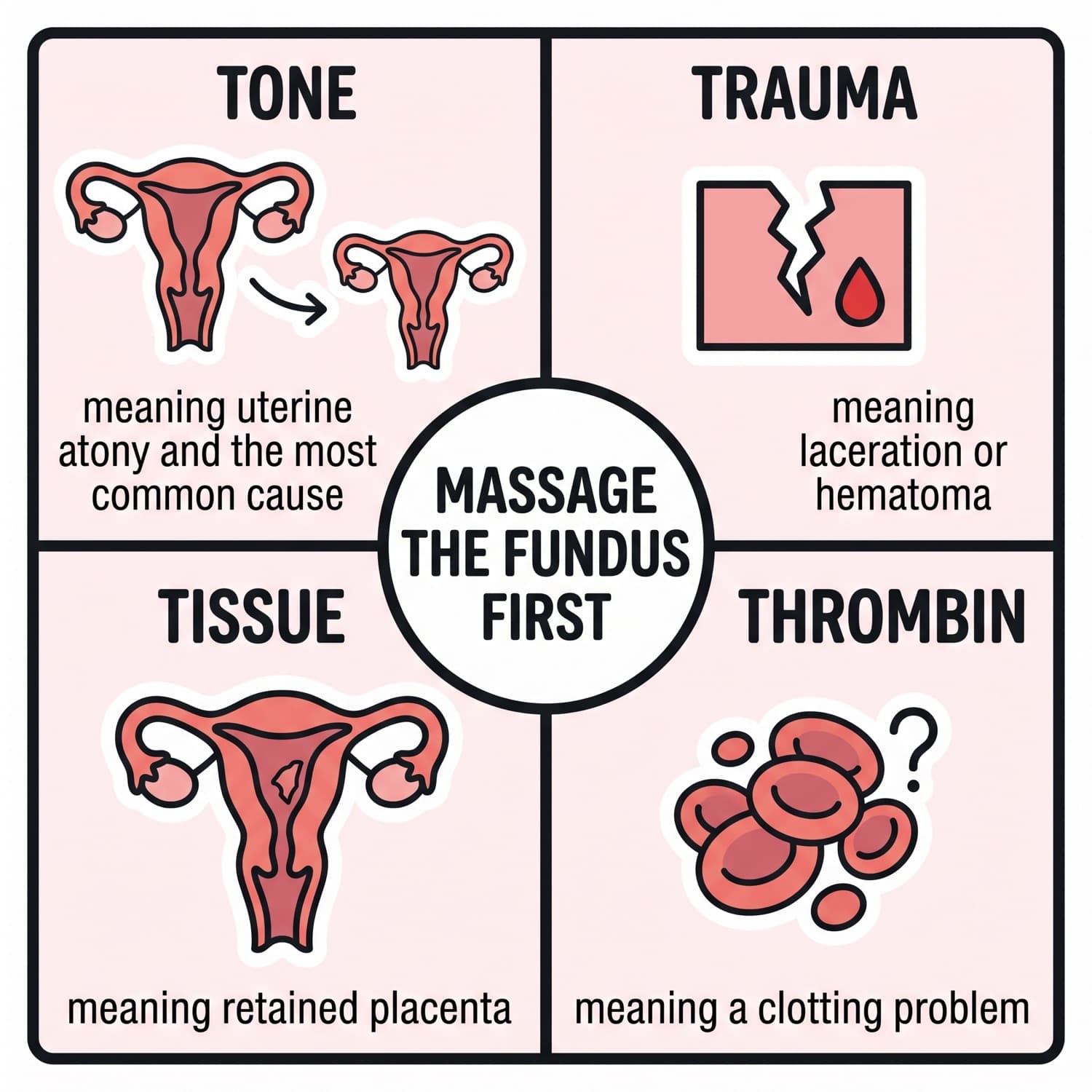
Causes: tone, trauma, tissue, thrombin. Uterine atony leads by a wide margin. Trauma covers lacerations, hematoma, and uterine inversion. Tissue covers retained placental fragments. Thrombin covers coagulopathy.
First actions, in order.
- Massage the uterine fundus with one hand supporting the lower uterine segment.
- Empty the bladder; a distended bladder displaces the uterus and prevents contraction.
- Call for help and administer uterotonics as ordered.
- Quantify the blood loss by weighing pads and measuring drainage, rather than estimating it visually.
- Establish large-bore intravenous access and begin ordered fluid resuscitation.
- Escalate: bimanual compression, intrauterine balloon tamponade, transfusion, and operative management.
Watch outthe contraindication pair the exam loves. Methylergonovine is withheld in hypertension and preeclampsia. Carboprost is withheld in asthma. Class logic → BOOK 05 · P9
PANEL 3 · THE OTHER THREE
- Uterine rupture. Sudden sharp abdominal pain, loss of station with the presenting part retracting, cessation of contractions, maternal tachycardia and hypotension. An abnormal fetal heart rate, frequently a prolonged deceleration or bradycardia, is often the first sign. Immediate surgical birth and laparotomy.
- Shoulder dystocia. The head delivers and then retracts against the perineum. Hyperflex the maternal hips onto the abdomen and apply suprapubic pressure. Never fundal pressure, which drives the shoulder harder into the symphysis. Document the clock.
- Amniotic fluid embolism. Abrupt hypoxia and dyspnea, then cardiovascular collapse, then coagulopathy. Support airway, breathing, and circulation, transfuse, and maintain left uterine displacement throughout resuscitation.
Memory hookTONE · TRAUMA · TISSUE · THROMBIN, in that order of likelihood.
Margin notehypovolemic shock → BOOK 09 · P7. Blood product administration → BOOK 15 · P6
Takeawayin cord prolapse the nurse's hand is the intervention; in postpartum hemorrhage the fundus and the bladder come before the drug.