
Move, Lift, Position, and the Care That Fills the Rest of the Shift
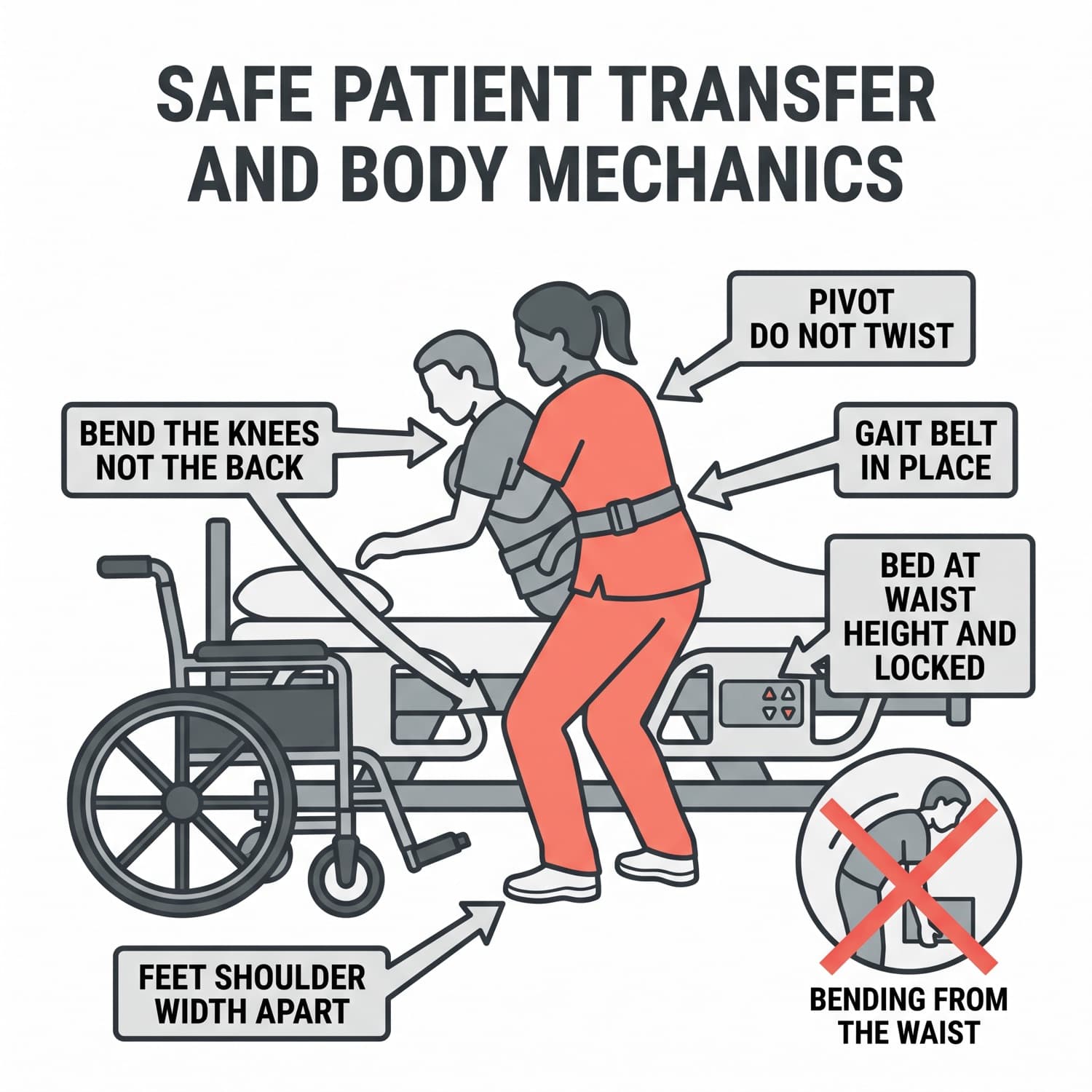
Strip 1 · Body mechanics Raise the bed to waist height, lock the wheels, widen the base of support, bend at hips and knees rather than the waist, keep the load close to your center, push rather than pull, and pivot with the feet so the spine never twists under load. Assistive devices and lift teams come before manual lifting, which is the last resort.
Strip 2 · The transfer sequence Assess mobility and cognition first, then gather help and equipment, then apply the gait belt. Place the chair on the patient's stronger side. Sit the patient at the edge of the bed and let orthostatic symptoms declare themselves. Stand on a count, with the patient doing the work they are able to do.
Strip 3 · Devices and stairs The cane goes on the stronger side and advances together with the weaker leg. The walker is advanced first, then stepped into. On stairs the stronger leg leads going up, and the weaker leg with the crutches leads going down.
Strip 4 · Positioning Semi-Fowler's for breathing and for any feeding. Side lying with a tilt off the trochanter rather than square onto it. Heels lifted clear of the mattress rather than propped on a ring. No pillow behind the knees. Repositioning frequency is individualized to risk rather than fixed by a universal clock.
Strip 5 · Elimination Scan the bladder for retention before assuming output is absent. Toileting schedules, pelvic floor exercises, fluid and fiber, and mobility are the first-line bladder and bowel measures. For an enema, use the left lateral Sims position, instill slowly, and pause when the patient cramps.
Strip 6 · Specimens Midstream clean catch into a sterile container. To start a timed urine collection, discard the first void and include the last. Collect sputum early in the morning after a water rinse, from a deep cough rather than saliva. Take a wound culture from the cleansed wound bed, never from drainage or eschar. Label at the bedside with two identifiers in front of the patient.
Strip 7 · Sleep and sensory aids Cluster care to protect uninterrupted blocks. Older adults spend less time in deep sleep and wake more often, which is expected rather than treated by default. Check the hearing aid battery and insert with the volume low. Face the patient, lower the pitch of your voice rather than raising the volume, and orient a visually impaired patient to a room that is then not rearranged.
Strip 8 · End of life and postmortem Mouth care, repositioning, and presence are the interventions. Cool mottled extremities, changed breathing patterns, and airway secretions are expected and are managed for comfort. After death, follow institutional policy and law: raise donation through the designated requester, honor cultural and religious practices, and in any case referred to the medical examiner leave every tube, line, and drain in place.
Memory hookUP WITH THE GOOD, DOWN WITH THE BAD.
Margin noteset the room up before you touch the patient.
Watch outa transfer that begins with the bed unlocked has already gone wrong. Lock, then touch.
TakeawayEvery safe move is decided before it starts.
Delegation of ambulation and hygiene → BOOK 03 · P5. Prone positioning in acute respiratory failure → BOOK 09 · P7.