
Type I versus Type II failure, and the oxygen ladder that separates them
Two failures, two columns
| TYPE I · HYPOXEMIC | TYPE II · HYPERCAPNIC | |
|---|---|---|
| What is wrong | Oxygen will not load onto blood | Air will not move in and out |
| Who presents this way | Pneumonia, acute respiratory distress syndrome, pulmonary edema, embolism, atelectasis | Chronic obstructive pulmonary disease exacerbation, late severe asthma, opioid or sedative excess, myasthenic crisis, Guillain-Barré syndrome, flail chest, obesity hypoventilation |
| What the patient looks like | Tachypneic, anxious, sitting forward, working visibly hard, saturation falling despite the effort | Sleepy, shallow, flushed, complaining of headache, hands with a flapping tremor, rousable but not stayed roused |
| What the gases do | Oxygen tension low, carbon dioxide normal or low from blowing off → BOOK 07 · P4 | Carbon dioxide rising with acidemia → BOOK 07 · P4 |
| First device | Escalating oxygen, then high-flow nasal cannula | Non-invasive positive pressure with two pressures |
| Where it escalates | Continuous positive airway pressure, then intubation | Intubation and invasive ventilation |
| What kills them | Hypoxia | Narcosis, then apnea and arrest |
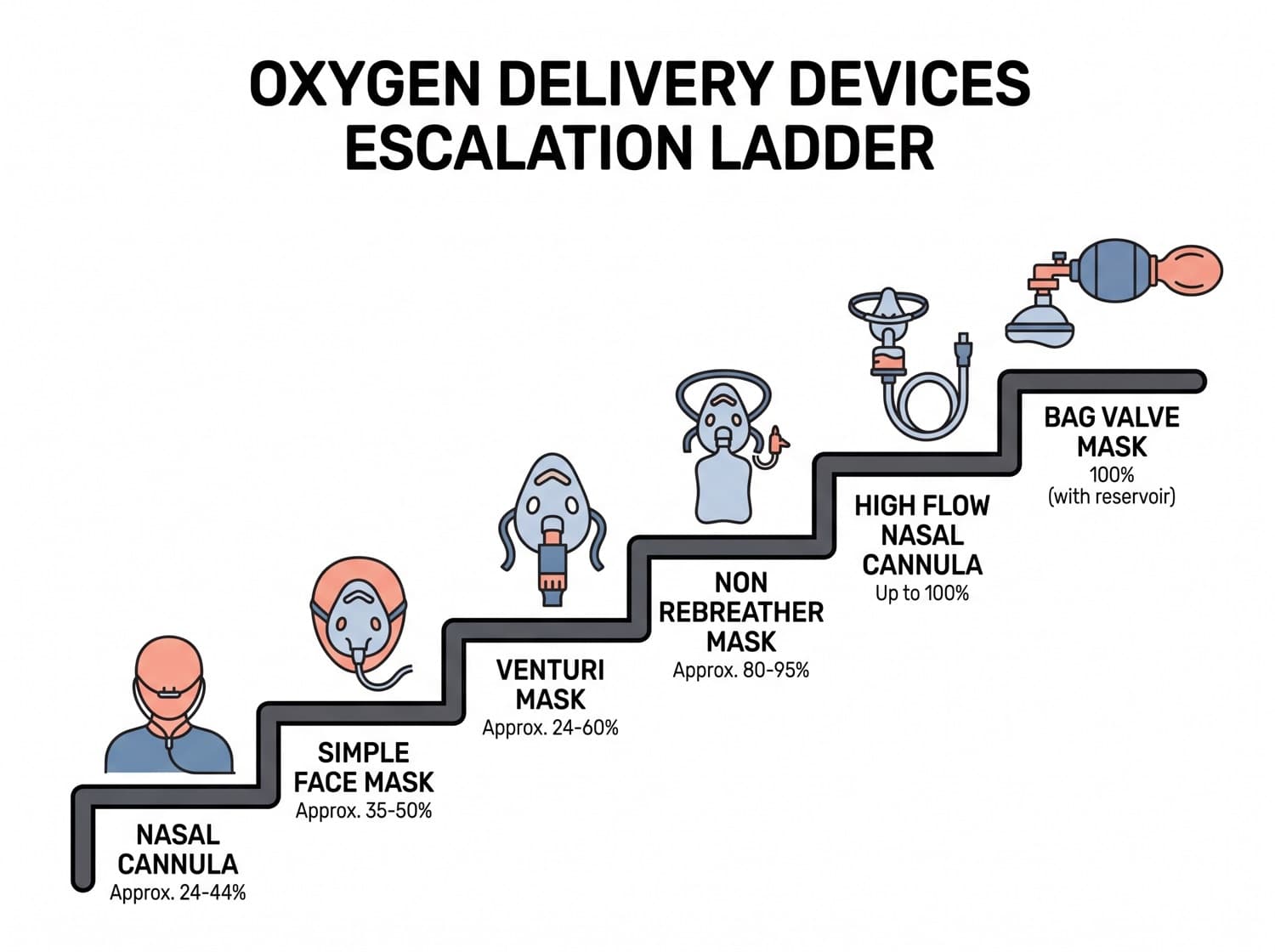
The oxygen ladder
| Device | Flow range | Approximate delivered oxygen | Escalate when |
|---|---|---|---|
| Nasal cannula | 1 to 6 liters per minute | 24% to 44% | Saturation below target at 6 liters per minute, or drying and nasal discomfort |
| Simple face mask | 6 to 10 liters per minute | 35% to 50% | Below target at 10 liters per minute. Never run below 6 liters per minute, or exhaled carbon dioxide is rebreathed |
| Venturi mask | Set by the color-coded adapter, commonly 2 to 15 liters per minute | A precise 24% to 50%, selected by adapter | Below target on the highest adapter. Chosen when the delivered percentage must be exact |
| Non-rebreather with reservoir | 10 to 15 liters per minute | About 60% to 90% with a good seal | Reservoir collapses on inspiration, or saturation stays below target at 15 liters per minute |
| High-flow nasal cannula | Up to about 60 liters per minute | 21% to 100%, heated and humidified, with a small positive pressure effect | Rising work of breathing or falling saturation despite maximal flow and percentage |
| Continuous positive airway pressure | Device-determined | Up to 100% | Persistent hypoxemia, or fatigue |
| Bilevel positive airway pressure | Device-determined | Up to 100% | Carbon dioxide still rising, mental status falling, or airway no longer protected |
| Bag-valve-mask with reservoir | 15 liters per minute | Close to 100% | This is the bridge, not a destination. Call for the airway |
| Invasive mechanical ventilation | Set on the ventilator | 21% to 100% | Terminal rung of the ladder |
The chronic retainer sentence
In a patient with chronic carbon dioxide retention, oxygen is titrated to a lower target saturation band rather than run wide open, because generous oxygen worsens ventilation-perfusion matching in diseased lung and shifts carbon dioxide off hemoglobin. Oxygen is titrated, never withheld from a hypoxemic patient. The target band itself is → BOOK 07 · P7.
Watch outNon-invasive ventilation is not for the patient who cannot protect an airway, who is vomiting, who has facial trauma, or who is apneic. That patient needs a tube.
Margin notebilevel for the sleepy one, high flow for the gasping one.
Bronchodilator and steroid pharmacology is named as a category only: → BOOK 05 · P6.
TakeawayHypoxemia buys a device that adds oxygen. Hypercapnia buys a device that adds breaths.