
Decelerations, read by their timing
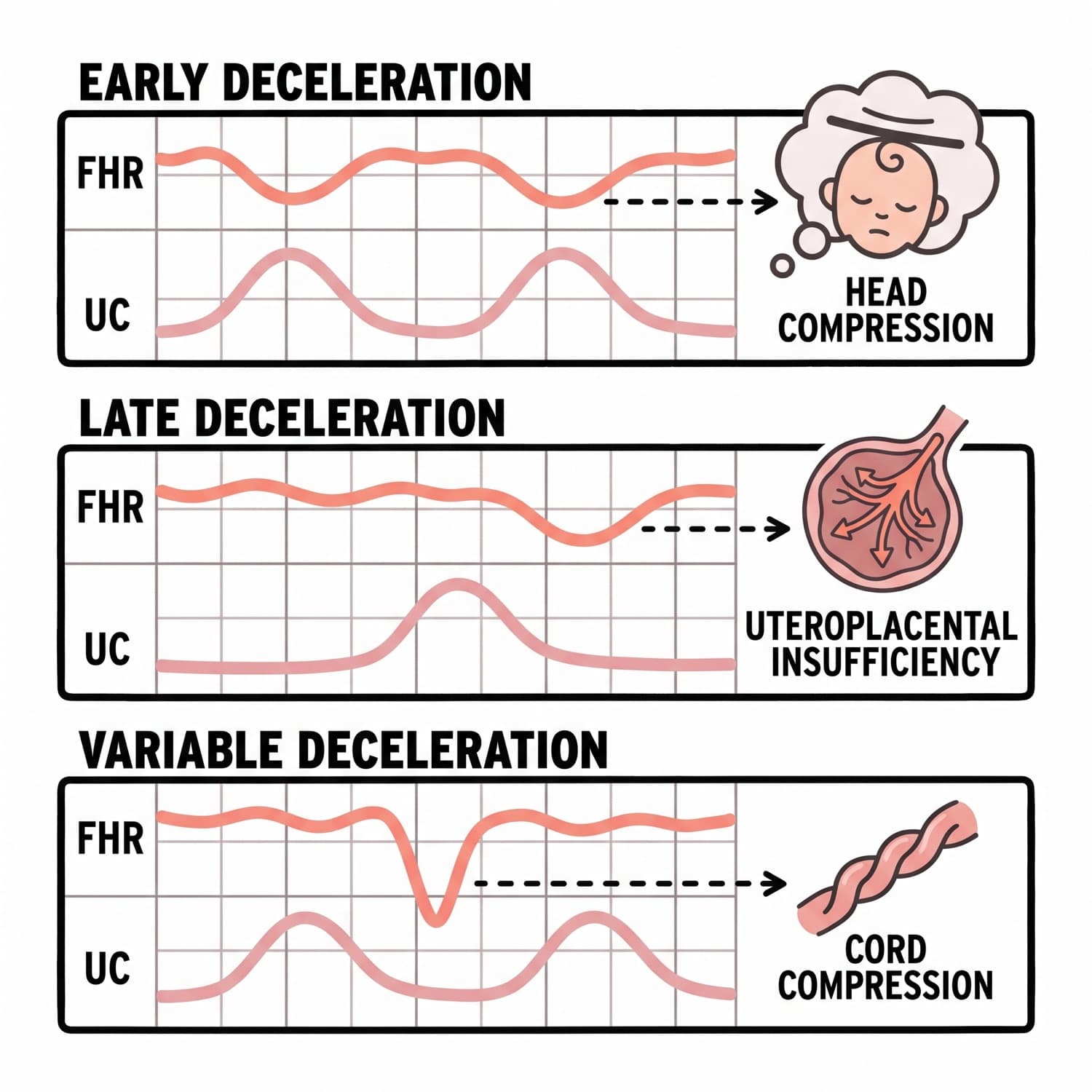
DECELERATIONS, READ BY THEIR TIMING
Every deceleration is named by two things: whether its onset to nadir is gradual or abrupt, and where its nadir sits relative to the contraction. Thirty seconds is the dividing line. Onset to nadir of thirty seconds or more is gradual. Less than thirty seconds is abrupt. Everything else follows.
| EARLY | LATE | VARIABLE | PROLONGED | |
|---|---|---|---|---|
| Shape and onset | Gradual, visually apparent, usually symmetrical decrease and return; onset to nadir 30 seconds or more | Gradual decrease and return; onset to nadir 30 seconds or more | Abrupt decrease; onset to nadir less than 30 seconds; decrease of 15 beats per minute or more below baseline, lasting 15 seconds or more and less than 2 minutes | Decrease of 15 beats per minute or more below baseline, lasting 2 minutes or more but less than 10 minutes; 10 minutes or more is a baseline change |
| Timing against the contraction | Nadir occurs at the same time as the peak of the contraction; mirrors the contraction | Onset, nadir, and recovery are all delayed; nadir occurs after the peak, recovery after the contraction ends | No fixed relationship to contractions; may occur with them or without them | A single sustained fall; timing independent of any contraction |
| Mechanism | Fetal head compression producing a vagal response | Uteroplacental insufficiency; the exchange surface cannot meet demand during the contraction | Umbilical cord compression | Sustained interruption anywhere in the pipeline: prolapse, rupture, tachysystole, maternal hypotension, seizure, or rapid descent |
| Nursing response | No intervention. Continue to monitor and document | Full intrauterine resuscitation, in sequence | Reposition first, side to side or knee-chest; vaginal exam to rule out prolapse; consider amnioinfusion for recurrent variables per order | Emergency until proven otherwise. Vaginal exam immediately, begin intrauterine resuscitation, prepare for expedited birth |
INTRAUTERINE RESUSCITATION, IN ORDER
- Reposition the patient to a lateral position, side to side as needed.
- Stop the oxytocin infusion.
- Open the maintenance intravenous fluid or give the ordered bolus.
- Perform a vaginal examination to rule out cord prolapse and assess descent.
- Consider a tocolytic for tachysystole, per order.
- Give supplemental oxygen by nonrebreather mask if ordered.
- Notify the provider.
- Prepare for possible operative or expedited birth.
Margin noteposition, oxytocin, and fluids lead the list. Current ACOG guidance describes limited evidence for routine maternal oxygen, so oxygen is given as an ordered intervention, not as a reflex first step.
NICHD THREE-TIER CATEGORIES
- Category I. All of the following: baseline 110 to 160 beats per minute; moderate baseline variability; late or variable decelerations absent; early decelerations present or absent; accelerations present or absent. Normal. Routine care.
- Category II. All tracings not Category I and not Category III. Indeterminate. Continued surveillance, evaluation, and intrauterine resuscitation as indicated.
- Category III. Either absent baseline variability with any one of recurrent late decelerations, recurrent variable decelerations, or bradycardia; or a sinusoidal pattern. Abnormal. Prompt evaluation and delivery preparation.
Recurrent means the pattern occurs with at least half of the contractions in a twenty-minute window.
Watch outlate decelerations with minimal or absent variability are the pattern that kills. Moderate variability is the single most reassuring finding on a strip and it outranks the presence of a deceleration.
Memory hookVEAL CHOP MINE. Variable — Cord compression — Move the patient. Early — Head compression — Intervention not needed. Accelerations — Okay — No action. Late — Placental insufficiency — Execute intrauterine resuscitation.
Margin notethe mnemonic sorts them. The mechanism answers them. Prolapse and rupture in full → BOOK 12 · P9. Tocolytic class logic → BOOK 05 · P9. Oxytocin math → BOOK 06 · P3
Takeawaytiming names the pattern, mechanism names the action, and late means the nadir comes after the peak.