
Age Is the First Assessment Finding
The filter
A respiratory rate of 40 breaths per minute is expected in a two-month-old and a warning sign in a nine-year-old. A parent who will not leave the bedside is appropriate for a toddler and a finding to explore in an adolescent. Squatting on a playground is a game at four and a compensatory posture in a child with an unrepaired cyanotic heart defect. Same finding, different answer. The variable is age.
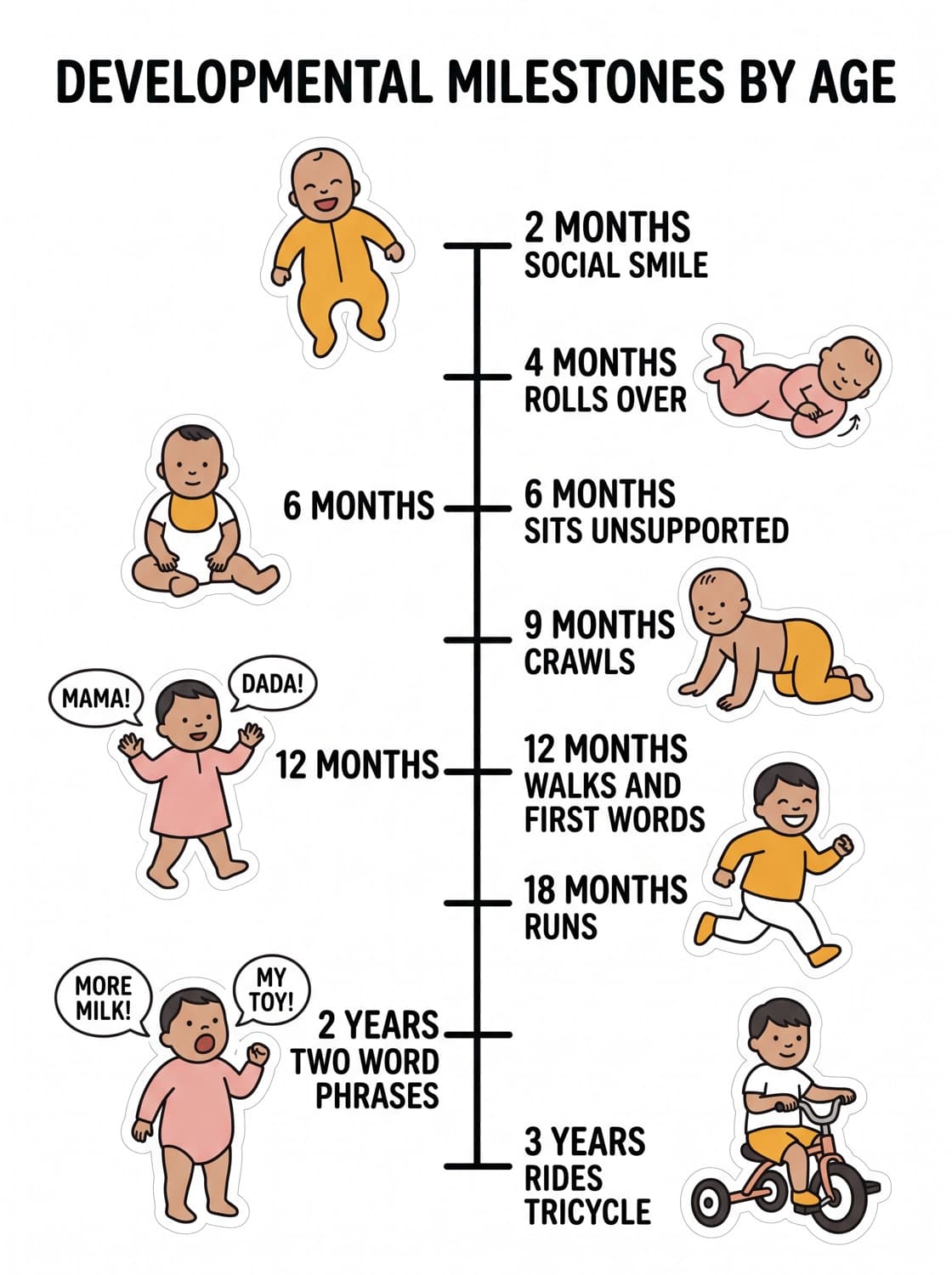
The milestone ladder
| Age | Gross motor | Fine motor or language | Social |
|---|---|---|---|
| 2 months | Lifts head when prone | Follows an object to midline | Social smile |
| 4 months | Rolls front to back, no head lag | Brings hands together, laughs | Smiles spontaneously at people |
| 6 months | Sits with support | Transfers object hand to hand, babbles | Knows familiar faces |
| 9 months | Crawls, pulls to stand | Emerging pincer grasp | Stranger anxiety, object permanence |
| 12 months | Cruises or walks | Two-word vocabulary beyond mama and dada | Waves bye-bye, plays pat-a-cake |
| 18 months | Runs stiffly, walks up steps | Stacks two to four blocks, points to wants | Imitates chores, temper tantrums |
| 2 years | Jumps with both feet, kicks a ball | Two-word phrases, half of speech understood | Parallel play, imitates others |
| 3 years | Pedals a tricycle | Copies a circle, three-word sentences | Takes turns, separates from a caregiver |
| 4 years | Hops on one foot | Draws a person with three parts | Cooperative play, speech clear to a stranger |
| 5 years | Skips, balances on one foot | Copies a triangle, counts ten objects | Follows rules, distinguishes real from pretend |
Red flags for delay watch
- No social smile by 3 months.
- Not sitting without support by 9 months.
- No babbling or gesturing by 12 months.
- No single meaningful words by 15 to 18 months.
- Not walking independently by 18 months.
- No two-word phrases by 2 years.
- Hand preference established before 12 to 18 months, which suggests weakness on the other side.
- Loss of any acquired skill at any age.
crit
Verify, do not recall. Every age above is a published, dated number. Milestone ages shift between editions and between sources, and the exam keys to the current published set. Check current AAP developmental surveillance guidance before answering from memory and before this page is reprinted.
Margin notethey build the whole question around one number. Watch out: regression is never normal. A toddler who was speaking and stopped, or a child who walked and no longer does, is referred the same day, not observed at the next visit.
Takeawayin a pediatric item the age is a cue, not a demographic detail. → BOOK 02 · P4